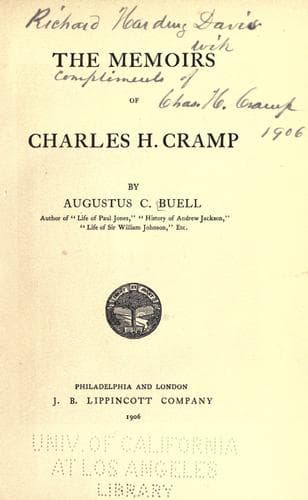
Cramp, Charles Henry, 1828-1913; Naval architects -- United States -- Biography
He was a great and successful manufacturer, a man of broad and keen
business instincts, and he thought that any scheme calculated to
disburse about seven million dollars among the workingmen and steel
mills of the United States was well worthy the earnest attention and the
best officers of the most dignified Ambassador. Imbued with such ideas,
Mr. Hitchcock helped Mr. Cramp all he could. He may not have been as
noisy about it as the German Ambassador or as strenuously in evidence as
the French Ambassador, but he was none the less active or effective in
his efforts to subserve and promote the interests of his country and her
citizens. The maw-worm doctrine of Buchanan and the raven-like croaking
of Bayard were lost upon such a man. Taking the situation altogether, it
is safe to say, so far as diplomatic representation was concerned, the
commercial and industrial interests of the United States and of American
citizens in the Russian Empire were quite as well guarded in 1898 as
were those of France and Germany.
The third element of opposition which Mr. Cramp had to encounter and
overcome was of a purely technical or mechanical character. His plans
involved installation of water-tube boilers of the Niclausse type. But
up to that moment, ever since the adoption of the water-tube system by
the Russian navy, the Belleville type of boiler had held undisputed sway
there. The enormous wealth of the Belleville people, their straightway,
open-handed mode of doing business with naval officials, not only in
Russia but in England as well, and their aptness in placing valuable
things where they would do the most good, were all notorious. They had
for some time admitted that the Niclausse system was their most
formidable rival, and naturally they were ready to exhaust their
resources to prevent its introduction into the Russian navy, where their
monopoly, up to that time, had been perfect and invulnerable. This
discussion was, of course, carried on wholly between Mr. Cramp and the
Russian technical authorities. It was a subject that could not be
touched by diplomacy or by personal influence; a contest to be fought
out wholly on the mechanical merits of the respective systems and
decided entirely by skilled judgment. In this kind of contest Mr. Cramp
was at home, and he won. His staple argument was that for any naval
power to surrender itself to a single type of proprietary boiler,
thereby creating a monopoly against itself, could not be else than
unwise; that the era of water-tube boilers was still in the experimental
stage, that perfection was yet to be developed, and was doubtless a long
way off. Exhaustive trials already made had demonstrated a wide range of
efficiency and consequent merit in the Niclausse system, and while it
was no part of his contention to decry or depreciate the rival type,
comparative performances of official record beyond dispute argued that
sound marine engineering policy would forbid the exclusion of the
Niclausse system.
Public-domain text, read in full here on John Shaqi.
Reviews
Reviews
No reviews yet
Be the first to share your thoughts on this work.
Elsewhere in the archive
Join the Discussion
Join the discussion
Sign in to leave a comment or review.
Sign InorCreate an account