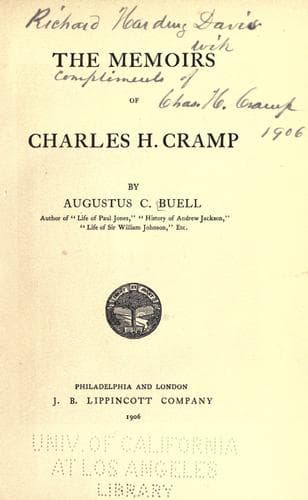
Cramp, Charles Henry, 1828-1913; Naval architects -- United States -- Biography
By the weight of these arguments Mr. Cramp carried all
his points. The ultimate result of a six weeks’ campaign was the award
of contracts for construction of six vessels in foreign shipyards: one
first-class battleship and one armored cruiser to the Forges et
Chantiers, of France; one first-class battleship and one large protected
cruiser of the highest attainable speed to Mr. Cramp, and two protected
cruisers of type similar to the last-named to Germany yards, the
“Germania” of Kiel and the “Vulcan” of Stettin.
Upon these awards, Mr. Cramp came home and began construction at once.
Indeed, while still in St. Petersburg, he had placed orders for
important parts of the material required, and had contracted for the
necessary armor. At the outset some delay occurred, due to the extreme
deliberation observed by the Russian Inspectors in approving detail
plans and specifications, and to some changes made in the character and
quality of material for protective decks after the contract was signed.
But notwithstanding these delays, Mr. Cramp completed and delivered both
his ships long in advance of either the French or German builders, and
such time penalties as had accrued by reason of the initial delays
already referred to were remitted by direction of the Emperor Nicholas
II himself.
The trial conditions imposed upon these ships were the most drastic and
crucial ever known; they being required to develop their maximum speed
for twelve hours continuously, as against four-hour or measured mile
trials in other navies.
Upon the completion and delivery of these ships, Mr. Cramp had achieved
the distinction of having done the greatest volume and highest value of
ship-building for foreign accounts ever performed in an American
shipyard. On their arrival at St. Petersburg, both ships were personally
inspected by the Emperor, who was so pleased with the “Variag” that he
ordered her detailed as escort to the Imperial yacht in a trip to
Cherbourg.
It is worthy of remark that in the fall of 1898 our Navy Department
advertised for proposals to construct three battleships, now known as
the “Maine” class. The plan put forth by the Department was a modified
and slightly enlarged “Alabama,” with a speed requirement of seventeen
knots as against sixteen in the original type. Mr. Cramp offered to
build an eighteen-knot ship within the statutory limit prescribed for
one of seventeen knots, and used his Russian battleship as a basis of
design. His proposition was accepted, and the other bidders—Newport News
and the Union Iron Works, to each of whom one ship was awarded—were
required to adopt Mr. Cramp’s conditions of dimension and performance.
In this manner the American navy as well as the Russian profited by Mr.
Cramp’s interesting and remarkable “Campaign of 1898.”
------------------------------------------------------------------------
CONCLUSION
Public-domain text, read in full here on John Shaqi.
Reviews
Reviews
No reviews yet
Be the first to share your thoughts on this work.
Elsewhere in the archive
Join the Discussion
Join the discussion
Sign in to leave a comment or review.
Sign InorCreate an account