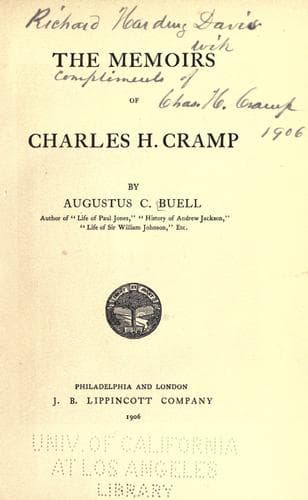
Cramp, Charles Henry, 1828-1913; Naval architects -- United States -- Biography
from the sale of her cargo over and above the $185,000 he had paid as
ransom. He was also offered a large sum for the ship herself to fit out
as a privateer, but part of his agreement with the British captain was
that she should not be used for that purpose, and so she was laid up
during the rest of the war.
Upon the conclusion of peace in 1815, the India and China trade of
Philadelphia was renewed with great vigor, and ship-building became more
brisk than ever before.
The war had nearly obliterated the whaling fleet of New England and New
York. Unable to replace those lost or destroyed as quickly as they
desired in their own ports, the whaling owners resorted to Philadelphia,
and in the seven years between 1815-1822 sixty-four ships, ranging from
three hundred to four hundred tons, were built on the Delaware for the
whale fishery to hail from New Bedford, Nantucket, New London, Sag
Harbor, and other whaling ports. A peculiarity of these transactions was
that most of the contracts for building whale-ships were taken by New
England builders and then sublet to Philadelphia yards.
At the same time, that is, in the decade following the peace of 1815, a
new element of ocean commerce came into being. This was the inauguration
of regular packet-lines. The pioneer of this enterprise on any
considerable scale was the famous “Cope Line,” founded by Thomas P. Cope
in 1820, and employing at first five ships which were among the largest
and best vessels then afloat. This line continued to run until the Civil
War. Its ships were from five hundred and sixty to one thousand two
hundred and eighty tons. They sailed from Philadelphia the 20th of each
month and from Liverpool the 8th, their trip-time averaging thirty days
and being almost as regular as the modern steamship lines. In addition
to this regular monthly service, extra ships were frequently despatched
as the exigencies of trade and travel might require.
Mr. Cramp, in one of his reminiscences, relates an interesting anecdote
of the Cope Line. Soon after Jackson was inaugurated President, he
appointed John Randolph, of Roanoke, Minister to Russia. The Cope Line
being then far ahead of all other channels of ocean travel from
Philadelphia to Europe, Mr. Randolph presented himself at its
shipping-office. In his usual grandiloquent manner he said to the first
man he encountered: “Sir, I want to see Thomas P. Cope.” He was shown to
Mr. Cope’s office, and said to him, “I am John Randolph of Roanoke. I
wish to take passage to Liverpool in one of your ships.” Mr. Cope
replied, “I am Thomas Cope; if thee goes aboard the ship and selects thy
state-room and will pay $150, thee may go.” Mr. Cope apparently could
see no reason why a Philadelphia ship-owner and head of a great packet
line should stand in awe of even a Virginia statesman.
Public-domain text, read in full here on John Shaqi.
Reviews
Reviews
No reviews yet
Be the first to share your thoughts on this work.
Join the Discussion
Join the discussion
Sign in to leave a comment or review.
Sign InorCreate an account