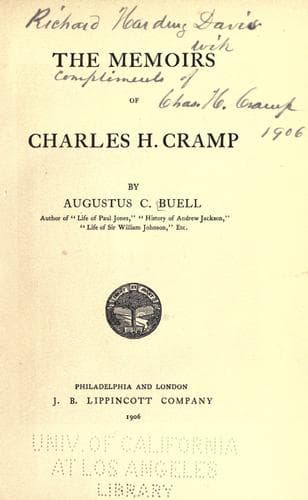
Cramp, Charles Henry, 1828-1913; Naval architects -- United States -- Biography
About 1828-30 the India and China trade of Philadelphia suddenly
declined, and in a few years passed almost entirely into the hands of
New York and Boston. In a historical paper, Mr. Cramp describes the
conditions of this traffic at its zenith, and suggests the cause or
causes of its remarkable decline.
The custom, he says, was upon the arrival of the vessels to announce in
the papers not only of Philadelphia but also of New York, Boston,
Baltimore, and even less important cities, that the goods would be sold
at auction, to begin on a certain day. These auction sales brought great
numbers of merchants from other cities to Philadelphia, and during the
first quarter of the nineteenth century it was beyond doubt the most
profitable single line of traffic on the continent. The merchants
engaged in it were not mere buyers and sellers as the term is understood
now. They were important public characters, diplomatists and financiers,
and their influence extended to the remotest parts of the earth. They
amassed enormous fortunes and lived like princes. Some of them, either
singly or in associations, owned fleets that would compare favorably
with our then existing navy in numbers and tonnage. At its highest
development, say, between 1825 and 1836, the volume of Philadelphia’s
Oriental trade frequently reached sixty millions a year.
[Illustration: CRUISER YORKTOWN]
Finally, however, causes began to operate which gradually changed the
tide of affairs. These causes, as stated in the historical paper by Mr.
Cramp, were numerous. Among them was the fact that, as the original
merchants who had built up the trade grew old or died, their immediate
heirs or descendants did not care to carry on the enterprises of their
fathers or their grandfathers, and many of them lived permanently
abroad. Eventually, at the moment when the jealousy, envy, and ambition
of rivals, particularly in New York and New England, had reached the
critical stage, the Legislature of Pennsylvania enacted a law imposing a
certain tax on all auction sales within the State. This was a tax
ostensibly universal and covering the whole business of sales by
auction, but its real purpose was to get at and derive revenue from the
great auction business of the China and India trade of Philadelphia. In
those days it might easily happen that the auction sales of two or three
ships’ cargoes would exceed in value, and therefore in revenue, all the
rest of the auction sales in the State at large during the same time.
Of course, this was a development of a tendency on the part of the rural
or country legislator of that time, which unfortunately has not entirely
died out, to tax the great cities by special enactments for the benefit
of the general revenue of the State.
Public-domain text, read in full here on John Shaqi.
Reviews
Reviews
No reviews yet
Be the first to share your thoughts on this work.
Join the Discussion
Join the discussion
Sign in to leave a comment or review.
Sign InorCreate an account