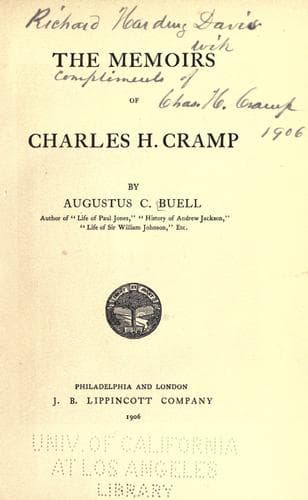
Cramp, Charles Henry, 1828-1913; Naval architects -- United States -- Biography
The Millers and Byerlys of the mother’s family were also ship-builders.
Mr. Cramp’s maternal grandfather, Henry Miller, who had become
proficient as a shipwright, at twenty-one invested his small fortune in
an interest in the cargo of a vessel in one of the earliest voyages
after the Revolution from the port of Philadelphia to the East, taking
in China, the Indies, and the Philippines. His departure was witnessed
by his fiancée, Elizabeth Byerly, who waited faithfully and patiently
his return.
These vessels were fitted out “man-of-war fashion,” with the captain and
mates, carpenter and boatswain as officers, and the latter were the
battery commanders.
They always carried a supercargo, and sold the cargoes at the various
ports and invested the proceeds in China shawls, teas, spices, and other
products of the East.
At that time the waters of the East Indies and China swarmed with
adventurers, pirates, rovers, and privateers; and the armed merchantmen
had frequent brushes with them. In fact, many merchantmen of that time
became imbued with the restless, adventurous spirit of the age and,
commanding vessels heavily armed, took possession of some of the weaker
ships they encountered, becoming veritable pirates for a time, and then
returning to their homes under peaceful guise when the profits of their
voyage had reached a satisfactory figure. The foundations of many
fortunes in our Atlantic cities were laid upon such practices.
Mr. Miller embarked again with his augmented capital, in fact, making
four voyages, each time with the profits of previous voyages in the new
one, encountering many adventures with the pirates that infested the
waters of the East and with an occasional privateer.
It was on his return from the fourth voyage when he, with the
accumulations of his original venture sufficient to secure a life of
ease and comparative luxury, and eager to meet his fiancée, who would be
patiently awaiting his arrival, was in sight of Cape Henlopen, with the
full assurance that his voyages were ended and with every anticipation
of a happy consummation of his eager wishes, a large privateer carrying
a French flag hove in sight in a position of advantage.
The privateer, carrying a heavier armament and larger crew, captured the
vessel before she could get inside of the Capes, and took the whole
party to Martinique, where the whole property was confiscated and all
the crew and officers were put in jail.
Mr. Miller, who was a Mason, was astonished to find that the French
jailer was also one, and, as a mark of kindness, took him out and made a
body-servant of him. His ingenuity and adaptability to circumstances
enabled him to escape, and he reached Philadelphia without a cent and
but little raiment. When Elizabeth Byerly was seen next day on
Point-no-Point Road in a buggy with him, she looked as happy as if
fortune was already in her hands. When they were married the next day, a
serviceable loan from a friend facilitated the marriage festivities.
Public-domain text, read in full here on John Shaqi.
Reviews
Reviews
No reviews yet
Be the first to share your thoughts on this work.
Join the Discussion
Join the discussion
Sign in to leave a comment or review.
Sign InorCreate an account