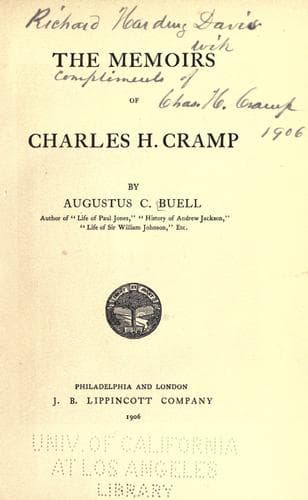
Cramp, Charles Henry, 1828-1913; Naval architects -- United States -- Biography
His restless, adventurous spirit, augmented by his voyages at sea, now
took a different turn, and his time was taken up by trips from Pittsburg
to New Orleans in arks that he and his companions built in Pittsburg,
and with cargoes of produce and other freight they floated down the Ohio
and Mississippi, relieving each other at steering or playing the violin
and taking an occasional shot at a deer that would be found swimming
across the river. The rivers Ohio and Mississippi ran through a
wilderness at that time, and its fascinations had a wonderful effect on
him.
After the cargoes and the lumber of which the arks were built were sold
and the proceeds lost in speculation, they would make their way up to
Natchez or other river towns, where they would be sure to get a
steamboat or a flat boat or two to build, and then return to
Philadelphia for a while. Henry Miller became well known on the rivers,
and could always secure a commission to build the various craft that
were found in the waters of the West.
One of Henry Miller’s sisters married John Bennett, a ship-builder of
repute, who went to live in Bordentown while engaged with his sons at
Hoboken as shipwright and ship-builder for the celebrated Stevens
family. It was there that with other vessels they built the yacht
“Maria,” named after the wife of John Stevens. The building of the
“Maria” was an event, and Maria Stevens spent most of her spare time at
the yard in looking over her construction and finish. The Stevens
battery was begun during the Bennett period.
Mrs. Miller’s brother was John Byerly, and her sister married William
Sutton, both noted ship-builders. So when William Cramp, who had learned
his profession under Samuel Grice, married Sophia Miller, two families
of ship-builders were united.
Charles H. Cramp was two years old when his father acquired frontage on
the Delaware in Kensington and established a shipyard of his own.
This early enterprise of William Cramp, who was then twenty-three years
old, has since grown to be the great establishment known as The William
Cramp & Sons Ship and Engine Building Company.
It does not seem necessary here to recount the progress of that pioneer
enterprise. Suffice it to say that at the time when William Cramp
founded his shipyard it was one of fourteen on the Delaware at different
points on the river front between Southwark and Kensington, and it is
the only one of the fourteen that remains in existence.
Of Charles Henry Cramp’s childhood and early youth, it is not necessary
to speak here in detail. He was, it might be said, born into the
atmosphere of naval architecture and the art of ship-building, and from
his earliest activity he never practised or attempted to practise any
other profession.
Public-domain text, read in full here on John Shaqi.
Reviews
Reviews
No reviews yet
Be the first to share your thoughts on this work.
Join the Discussion
Join the discussion
Sign in to leave a comment or review.
Sign InorCreate an account