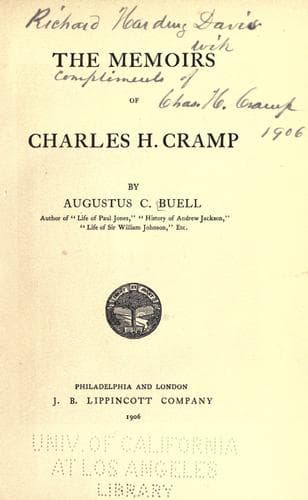
Cramp, Charles Henry, 1828-1913; Naval architects -- United States -- Biography
Only a part of them was built by Mr. Cramp, but they were all built upon
his plans. They were large surf-boats of three different sizes, and were
carried to Vera Cruz on the decks of schooners chartered for the
purpose. The thwarts were taken out of the larger boats and the smaller
ones of different sizes were stowed in them.
The “Standard History of the Mexican War” shows that out of the total
number (three hundred) designed by Cramp and contracted for with
different boat-builders, only one hundred and eighty-six (186) were
actually delivered and used, and in the operations against Vera Cruz,
General Scott’s army was landed by divisions. The Regular Division
commanded by General Worth was put on shore first, then the Volunteer
Division of General Robert Patterson, and, finally, the mixed Regular
and Volunteer Division of General Twiggs.
After these boats had been used for their original purpose they were
cast adrift. Their sea-worthiness may be estimated from the fact that
some of them were picked up in mid-Atlantic months afterward.
There are stories in history about invading armies burning their bridges
behind them, but this is unquestionably the only instance where an army
deliberately cast loose the boats in which it had landed upon the soil
of an enemy. Burning bridges might mean, and doubtless would, the simple
destruction of means of recrossing a river in the case of disaster, but
the destruction or dispersion of the boats in which Scott’s army landed
at Vera Cruz meant the obliteration of any possible means they might
have had of crossing a gulf and ocean had the fortune of war been
adverse to them.
Starbuck, in his “History of the American Whale-fishery,” refers to this
incident, and says that some of these boats were picked up by
whaling-ships, whose crews highly prized them, and that they were used
for years afterward in the sperm and right-whale fisheries of the
Pacific Ocean.
At the beginning of the career of Mr. Cramp in ship-building, the
profession had arrived at its highest state of efficiency in everything
that related to the design, finish, and outfit of ships. They were with
but few exceptions all of wood, and it was in the wooden ship and during
the period between 1840 and 1860 that the art and everything belonging
to it attained its highest proficiency. Ship-building as an art,
profession, and science culminated about this time,—the great transition
from wood to iron.
From the earliest period up to that time the professional ship-builder
or “master builder,” as he has always been called, was a master in
reality. He designed, modelled, and built his own ships, and his
appreciation of the beautiful and his artistic taste were of the most
refined and cultivated character, and were everything that the term
sculptor, artist, and constructor meant. He was acutely sensitive; his
contempt for the quack and commonplace in his profession was as great as
that of the physician in regular practice for the medical quack.
Public-domain text, read in full here on John Shaqi.
Reviews
Reviews
No reviews yet
Be the first to share your thoughts on this work.
Join the Discussion
Join the discussion
Sign in to leave a comment or review.
Sign InorCreate an account