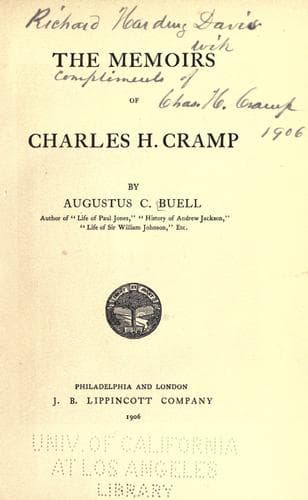
Cramp, Charles Henry, 1828-1913; Naval architects -- United States -- Biography
The builder, the shipwright, the commander, and sailor of this period
have never been equalled in any of their professions since, and with but
few exceptions the modern steel ship is a retrograde in everything
pertaining to the real art as compared to the ship of the period we
refer to. The ships, of course, are larger now, and that is all. This
period was not only noted on account of the high character of the art,
but ship-building plants in New York, Philadelphia, and Baltimore turned
out the finest specimens of construction in the world. All of the
workmen—shipwrights, ship-joiners, ship-smiths, ship-painters, and
caulkers—were without equals on the planet.
The Webbs, the Westervelts, the Steers family, Jere Simonson, Smith and
Dimon and others of New York, and John Vaughan, John Byerly, the Van
Duzen family, John K. Hammett and William Cramp, of Philadelphia, were
the leaders of their profession the world over. In the navy were to be
found the Grices, the Humphreys, the Hanscoms, Delano, and others.
The introduction of the iron ship was made under very unfavorable
conditions. The first to take hold of the new material were people,
mechanically speaking, of commonplace character both here and abroad,
and the art or profession as a rule retains the original taint up to
this time. There are some exceptions; some ship-builders in Great
Britain carried their art into the Iron Age,—the Napiers, the Ingliss
family, and others in Great Britain, and the Cramps in the United
States.
Mr. Cramp’s mould loft practice and methods as carried on from the
wooden-ship period is the practice now in use in the construction of the
navy.
The great advance in the steamship of the period thence up to this time
has been in the machinery; and in marine engineering the English were
our masters. There has been no advance here in the ship-building art in
any respect.
The decade following the Mexican War and preceding that of the Rebellion
was marked chiefly by the final or ultimate development of the clipper
type of sailing-vessel, and also by the gradual surrender of sail to
steam in propulsion and of wood to iron in construction. The clipper
idea was undoubtedly of Baltimore origin, and, in fact, the name of that
city was given to the type,—the “Baltimore Clipper.” They were, of
course, sailing-vessels. In all respects of model, of structure, size of
spars and sails, dimensions of hull, etc., the type was distinctly
American. It is known, however, that the earliest clippers built in
Baltimore were intended for and used in the African slave-trade. In this
nefarious traffic they were extremely successful, because in the day of
their beginning there were no steam cruisers to enforce the laws making
the slave-trade piracy, and there was no sailing cruiser afloat which
could keep within sight of a Baltimore clipper in the slave-trading
days.
Public-domain text, read in full here on John Shaqi.
Reviews
Reviews
No reviews yet
Be the first to share your thoughts on this work.
Join the Discussion
Join the discussion
Sign in to leave a comment or review.
Sign InorCreate an account