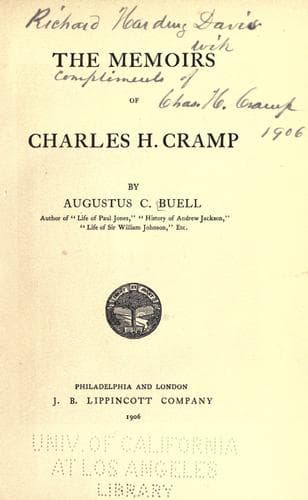
Cramp, Charles Henry, 1828-1913; Naval architects -- United States -- Biography
On the whole, so far as American ocean commerce and ship-building are
concerned, the decade of the 50’s was one of the most interesting in our
history. During that period the Cramp concern built from the designs and
under the superintendence of Charles H. Cramp a considerable number of
important sailing merchant vessels, together with several steamers,
mostly constructed for the coasting trade between the ports on the
Atlantic and on the Gulf. Cramp also built during that period seven
steamers for Spanish or Cuban account to be used in the coasting trade
of the Spanish West Indies. They were called “Carolina,” “Cardenas,”
“Alphonso,” “Union ‘Maisi,’” “General Armero,” and “Union No. 2.” The
last one was not finished until the outbreak of the Rebellion, when she
was taken possession of temporarily by the government and converted into
a gun-boat, now in the navy list as the “Union.” An interesting incident
in Mr. Cramp’s career was his visit to Havana for the purpose of
delivering these ships. In their delivery and in making settlement for
their construction he spent several months at Havana, where his
knowledge of the Spanish language, in which he always retained
considerable proficiency, was of great service to him.
The first war vessel designed by Mr. Cramp was the “Libertador,” built
for Venezuela. She was fitted with a pair of trunk engines by Messrs.
Sutton & Smith, who were noted for their skill in building trunk and
oscillating and other marine engines. She mounted a large pivot-gun on
her quarter-deck, and when fired off on her trial trip at Market Street,
the windows there were broken and the gun nearly kicked herself
overboard.
We now arrive at the period of the Civil War, in the operations
connected with which Mr. Cramp’s genius first became conspicuous in the
broad or national sense.
The work hitherto described, although important in its time and place
and under its conditions, which were those of peace, had really served
little more than the purpose of a practical training-school to fit him
for the broader and more comprehensive duties and responsibilities which
the exigencies of the Civil War imposed.
At the outbreak of that struggle, optimistic statesmen, like Mr. Seward,
dreamed that it would be over in ninety days. Those dreams went up in
the smoke of the first Bull Run. Then the authorities at Washington
awoke to the fact that they had on their hands a long and stubborn war.
Public-domain text, read in full here on John Shaqi.
Reviews
Reviews
No reviews yet
Be the first to share your thoughts on this work.
Join the Discussion
Join the discussion
Sign in to leave a comment or review.
Sign InorCreate an account