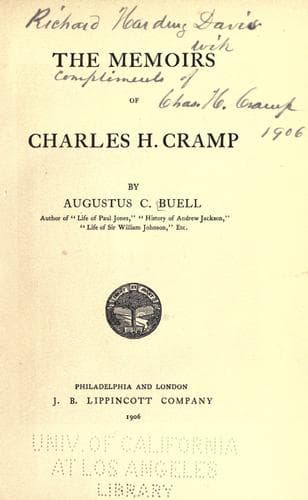
Cramp, Charles Henry, 1828-1913; Naval architects -- United States -- Biography
It is a fact not generally known, or usually lost sight of, that during
the first six months of the Civil War, that is to say from April to
September, 1861, inclusive, the South raised and embodied a larger
number of troops than the North did, and the scale in that respect did
not turn until the government had begun to realize the results of its
call for five hundred thousand men. But the problem that confronted our
authorities was not military alone. It soon became clear to sagacious
minds that a great sea power must be created as well as an overpowering
force by land. It was a foregone conclusion that notwithstanding the
great numerical disparity between the white population of the South and
that of the North,—the proportion being about six millions in the South
to twenty-five millions in the North,—it would be impossible to overcome
them so long as their ports remained open. If the Southern people could
continue without serious hindrance to exchange their cotton for
European, principally English, arms, ammunition, military supplies, and
munitions of war of all kinds, together with provisions and clothing of
the kind which they had habitually imported, their armies could keep the
field; their railroad system could be kept in fair running order, and
the numerical superiority of the North must thereby to a great extent be
neutralized. Therefore an effective blockade became an immediate and
absolute necessity.
The total coast-line of the Confederacy, Atlantic Ocean and Gulf
together, was three thousand six hundred miles long, measured in
straight lines. The shore-line, or sinuosities, was considerably more
than twice that length. It is a coast indented with numerous inland bays
and estuaries, affording easy access to the immediate interior and safe
refuge for their ships or the ships of those with whom they traded. Of
course, a mere blockade by proclamation would not be respected by any
foreign maritime power. Paper blockade so-called had been ruled out of
consideration years before in solemn congress or conference of the Great
Powers.
At that moment our navy was at its lowest ebb, and, of the few ships
available for immediate service, many were on foreign stations and could
not easily or quickly be recalled, as the cable system of communication
was then unknown.
The task therefore became that of immediately improvising a navy capable
of enforcing a real blockade. To accomplish this, before the end of 1861
every steamer of every description that could keep the sea or carry a
gun was pressed into the service, and our commercial fleet, so far as
steam navigation was concerned, ceased to exist.
These converted vessels served a fairly good purpose _ad interim_, or
until the government could bring its resources to build a more effective
fleet of regular men-of-war.
Public-domain text, read in full here on John Shaqi.
Reviews
Reviews
No reviews yet
Be the first to share your thoughts on this work.
Join the Discussion
Join the discussion
Sign in to leave a comment or review.
Sign InorCreate an account