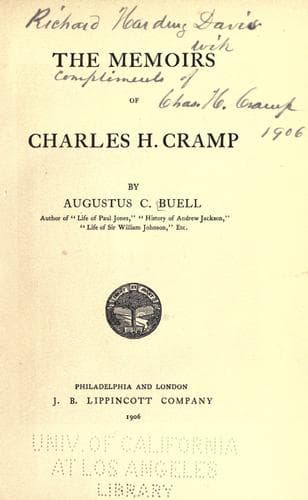
Cramp, Charles Henry, 1828-1913; Naval architects -- United States -- Biography
“When the contract was made for the ship, wages for shipwrights were
$1.75 per day, and in less than two months they rose to $3 per day.
We contracted for all the copper sheathing and bolts the day after
signing the contract at twenty-nine cents per pound; in four months
it was sixty cents per pound. Materials in general went up from 50
to 100 per cent. before we finished the ship.
“Great and radical changes have since occurred, but, primitive as
the ‘New Ironsides’ seems in comparison with modern battleships, it
is doubtful if any one now existing will ever see as much fighting
or make so much history as she did. Last July, in an address read
before the Naval War College at Newport, I said:
“‘I cannot better illustrate my point than by comparing the first
and the last sea-going battleships built and delivered to the
government by Cramp. The first was the ‘New Ironsides,’ built in
1862. The last is the ‘Iowa,’ completed in 1897. Each represented or
represents the maximum development of its day.
“‘The ‘New Ironsides’ had one machine, her main engine, involving
two steam-cylinders. The ‘Iowa’ has seventy-one machines, involving
one hundred and thirty-seven steam-cylinders.
“‘The guns of the ‘New Ironsides’ were worked, the ammunition
hoisted, the ship steered, the engine started and reversed, her
boats handled, in short, all functions of fighting and manœuvring,
by hand. The ship was lighted by oil lamps and ventilated, when at
all, by natural air currents. Though, as I said, the most advanced
type of her day, she differed from her greater battleship
predecessor, the old three-decker ‘Pennsylvania,’ only in four
inches of iron side armor and auxiliary steam propulsion. She
carried fewer guns on fewer decks than the ‘Pennsylvania,’ but her
battery was nevertheless of much greater ballistic power.
“‘In the ‘Iowa’ it may almost be said that nothing is done by hand
except the opening and closing of throttles and pressing of electric
buttons. Her guns are loaded, trained, and fired, her ammunition
hoisted, her turrets turned, her torpedoes, mechanisms in
themselves, are tubed and ejected, the ship steered, her boats
hoisted out and in, and the interior lighted and ventilated, the
great search-light operated, and even orders transmitted from bridge
or conning-tower to all parts by mechanical appliances.
“‘Surely no more striking view than this of the development of
thirty-five years could be afforded.’
“The battery of the ‘New Ironsides’ was mounted in broadside, and
she had eight ports of a side, out of which she fought seven 11-inch
Dahlgrens and one 200-pounder Parrott, the maximum train or arc of
fire being about 45 degrees.
Public-domain text, read in full here on John Shaqi.
Reviews
Reviews
No reviews yet
Be the first to share your thoughts on this work.
Join the Discussion
Join the discussion
Sign in to leave a comment or review.
Sign InorCreate an account