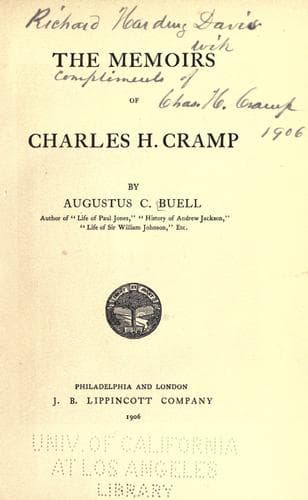
Cramp, Charles Henry, 1828-1913; Naval architects -- United States -- Biography
“After considerable investigation, the board decided to accept three
plans and award the contracts. They were the ‘New Ironsides,’ the
original ‘Monitor,’ and the ‘Galena.’ Those three vessels exhibited
a vast diversity in form, construction, and outfit.
“A number of fables have originated and have come to be believed as
truths about many of the circumstances attending the selection of
plans. Among others, it was said that Mr. Lincoln himself, being
impressed with the claims of Mr. Ericsson, had to interfere, and
ordered the board to select the ‘Monitor.’ This is entirely false,
for no such demonstration was ever made by Mr. Lincoln, and the
board was not influenced at all by any considerations of that or any
other kind except their own judgment.
“The contract for the ‘New Ironsides’ was awarded to Merrick & Sons;
the design, plans, and specifications of hull complete had been made
by me in connection with Mr. B. H. Bartol, who conceived the project
and had charge of the proposal to the government,—Mr. B. H. Bartol
was Superintendent of Merrick & Sons at that time. When the contract
was awarded to Merrick & Sons, they sub-let the hull together with
the fittings to our firm, in accordance with a previous agreement
with Mr. Bartol. The contract price was about $848,000. Merrick &
Sons furnished the engines and armor plate. The engines were
designed by I. Vaughan Merrick, and were duplicates of those which
they had completed for a sloop-of-war, and were for a single screw.
The speed was about seven knots. She was bark-rigged with bowsprit.
“After completing the ‘New Ironsides,’ I proposed to build two more
of similar type with certain modifications and improvements, that
is, sea-going iron-clads, with twin screws instead of a single one,
and in increasing the speed and the efficiency of the armor. But at
that time what was known as the ‘Monitor craze’ was in full blast,
and, notwithstanding the excellent all-around performance of the
‘New Ironsides,’ she remained the only sea-going broadside iron-clad
in the navy, and was the first to fire a gun at an enemy, and fought
more battles than all other sea-going battleships past and present
put together.
“The armor plate of the ‘New Ironsides’ was made partly at Pittsburg
and partly at Bristol, Pennsylvania, and was of hammered scrap iron.
It was four inches thick, and the plates, which could now be rolled
in many mills and be considered light work, were then looked upon as
marvels of heavy forging.
Public-domain text, read in full here on John Shaqi.
Reviews
Reviews
No reviews yet
Be the first to share your thoughts on this work.
Join the Discussion
Join the discussion
Sign in to leave a comment or review.
Sign InorCreate an account