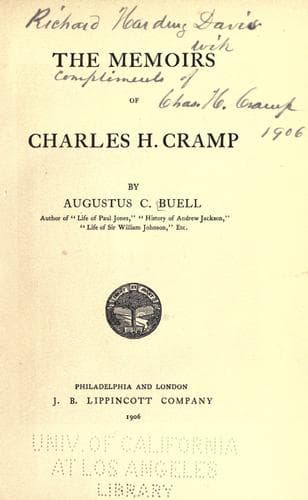
Cramp, Charles Henry, 1828-1913; Naval architects -- United States -- Biography
Partly through the natural unthinking enthusiasm of the people in times
of great excitement and partly through a carefully planned campaign of
sentiment adroitly managed by the ring, the monitor became almost the
symbol of patriotism.
After the repulse of the “Merrimac” in Hampton Roads, Ericsson was
almost deified, particularly by that class of people who consider rant
synonymous with eloquence. Yet such sentiments were actually cherished
at the time by a great many people who knew nothing whatever about the
actual merits of different types of vessels. But their fanaticism made
the operations of the monitor ring easy, and at the same time made it
impossible to introduce or carry forward any other type of armored
vessel during the whole Civil War, no matter how efficient or how
desirable it might be.
Captain Ericsson is popularly credited, and doubtless will be in
history, with the complete invention of the monitor. So far as the form
and structure of the hull, which was simply “scow bottom,” and the
fantastic type of its propelling engine and the Ericsson screw were
concerned, this is probably true, at least so far as known; but the main
distinguishing feature of the monitor was not its model of hull nor its
propelling engine, but its revolving turret; and this device had been
invented and patented by Mr. John R. R. Timby several years before the
outbreak of the Civil War. Timby had proposed to use the revolving
turret system for sea-coast defence, as a primary proposition. However,
in his description, upon which his letters-patent were issued, he
suggested that it might also be applied to floating structures or
batteries. All that Ericsson did in the application of the turret system
to his monitor was to appropriate Timby’s invention and act upon his
suggestion; a fact which was abundantly demonstrated afterward when Mr.
Timby received compensation for the infringement.
But all these facts probably went for little or nothing. It seemed that
the people had determined to make a demigod of Ericsson, and there was
no gainsaying them. They would have it so, and so it is.
Mr. Cramp, in a hitherto unpublished paper, deals with the history and
operations of the monitor ring with regard to its _personnel_ and the
details of its origin and methods, the origin of the “fast cruisers of
the navy,” and the “state of marine engineering of this country as it
existed at that time.” In this paper, as will be seen, he hews to the
line.
THE “MONITOR.”
“The coming out of the ‘Merrimac’ for the last time, and her
successful repulse by the ‘Monitor’ having driven her back into
Norfolk, gave a boom to the monitor system, the extent of which had
never been witnessed in this country before.
“The enthusiasm that always greets successful combats in war-time
was on this occasion of an extraordinary character, and the whole
country was aroused to the highest pitch of excitement.
Public-domain text, read in full here on John Shaqi.
Reviews
Reviews
No reviews yet
Be the first to share your thoughts on this work.
Join the Discussion
Join the discussion
Sign in to leave a comment or review.
Sign InorCreate an account