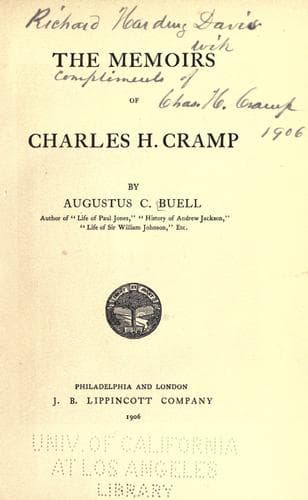
Cramp, Charles Henry, 1828-1913; Naval architects -- United States -- Biography
“The designer of the ship, John Ericsson, already well known as one
of the principal promoters and successful advocates of screw
propulsion, and Alban C. Stimers, who was engineer during the fight,
and some of the officers, were the recipients of the most
extravagant and hysterical demonstrations in the way of hero
worship.
“An illustration of the effect that this battle had on the popular
mind at that time may be found in an address of Bishop Simpson at
the Academy of Music in Philadelphia.
“During the war, frequent addresses were made throughout the country
by well-known orators, states-men, and ministers of the gospel,
intended to promote a patriotic spirit and encourage the doubtful.
“I was present at the Academy of Music shortly after the ‘Monitor’
had been made famous by repulsing the ‘Merrimac,’ when, in referring
to Mr. Ericsson, the Bishop stated that ‘the Almighty had directly
interposed in the contest between Captain Ericsson and Robert
Stephenson in England,’ both of whom had responded to the offer of
the Liverpool and Manchester Railway Company of a premium of £500
sterling for the most improved locomotive engine. This was at the
very beginning of the introduction of railways in Great Britain, and
the following engine entered for the prize:
“The ‘Novelty,’ by Ericsson and Braithwait; the ‘Rocket,’ by Robert
Stephenson; the ‘Sans Pareil,’ by Timothy Hackworth, the
‘Perseverance,’ by Mr. Burstall.
“Mr. Joseph Harrison states in his book, the ‘Locomotive Engine,’
that ‘the prize was easily won by the “Rocket,” built by George and
Robert Stephenson, having fulfilled, in some respects, more than all
of the requirements of the trial.’
“Bishop Simpson, in referring to this incident, said that ‘the
Almighty had interposed to prevent Captain Ericsson from succeeding
there, so that he might become disgusted with England and shake the
dust of that country from his feet and depart for America, in order
that he might be here ready to save the country.’
Public-domain text, read in full here on John Shaqi.
Reviews
Reviews
No reviews yet
Be the first to share your thoughts on this work.
Join the Discussion
Join the discussion
Sign in to leave a comment or review.
Sign InorCreate an account