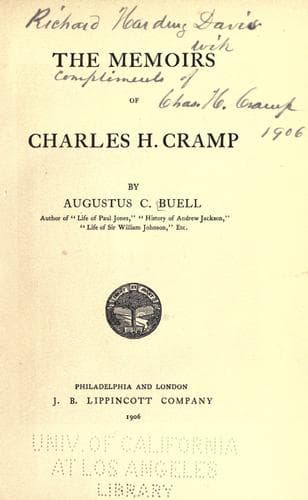
Cramp, Charles Henry, 1828-1913; Naval architects -- United States -- Biography
“The government promptly gave us one and the Harlan yard one, and
notified eighteen other bidders that they could have one each at the
same price as ours, which amounted, as near as I can remember, to
$350,000.
“Some of the bids ran as high as $750,000, and these bidders had
some delicacy in accepting prices at one-half, because, to accept
the contract at one-half, it would be an acknowledgment that they
did not know what they were about, or that they were trying to rob
the government.
“The fact is, that none of the bidders except Harlan & Hollingsworth
and ourselves were ship-builders. They were in other lines of
mechanical construction, and of course they did not have the
slightest idea of what was to be done or what it would cost.
“The drawings on which the vessels were to be built were of the
crudest character; only a midship section and one or two vague
longitudinal sketches being furnished as a guide or basis of
construction.
“Notwithstanding, as I said before, we were the lowest bidder,
thereby saving millions of dollars to the government, only one was
awarded to us. The balance was offered to the other bidders at our
price, and the offer was accepted by most of them.
“Having received our contract, we promptly visited New York to get
the details of construction and engines in order to begin work and
procure materials. The demand for materials was greater than the
supply, and all were in a feverish state of excitement. To get our
orders out quickly, I immediately made application to Mr. Stimers
for plans, and had a long and detailed conversation with him and
Theodore Allen over what plans they had developed, and numerous
alterations were made to the plans as drawn.
“Their first plan permitted the boilers to come within three and
one-half inches of the bottom plating of the ship, practically
landing the boilers on the three and one-half inch angle-bars, which
had at that time no floors.
“I suggested in a rather strong way that this would not do, and
after considerable discussion they concluded to make the vessels a
little deeper, give the deck more spring, and put shallow floors in.
Other important alterations were made as the work progressed.
“We would have had our vessel overboard first, but the northward
march of General Lee previous to the battle of Antietem interfered
with the furnishing of materials, and also with our own working
force in the shipyard.
“Our employees, with those of the rolling-mills supplying materials
near Philadelphia, organized themselves into military companies for
the purpose of defence. Two companies were formed in our
establishment.
Public-domain text, read in full here on John Shaqi.
Reviews
Reviews
No reviews yet
Be the first to share your thoughts on this work.
Join the Discussion
Join the discussion
Sign in to leave a comment or review.
Sign InorCreate an account