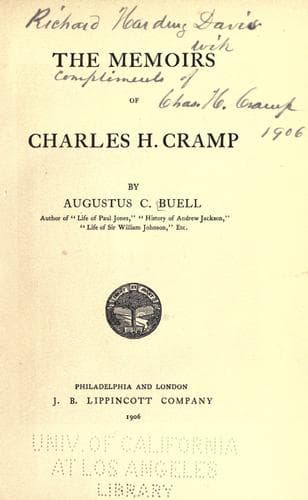
Cramp, Charles Henry, 1828-1913; Naval architects -- United States -- Biography
“Mr. Stimers and Mr. Allen were autocrats. They spent money
lavishly, ordered vessels, designed them, made contracts,
sub-contracts, made purchases, and carried everything with a high
hand.
“Mr. Lenthall, the Chief Constructor of the Navy, and Mr. Isherwood,
who was on his staff as engineer, were entirely set aside, and
practically disappeared from the scene as far as new constructions
were concerned.
“A large number of monitors were built, slightly improved in
structural detail over the original, and were engaged as soon as
finished in the operations before Charleston.
“The head-quarters in New York was often called the ‘draughtsmen’s
paradise,’ on account of the great number of draughtsmen employed
there, and who were getting twenty dollars a day. The most
extraordinary displays of drawings were issued to the various
machine-shops which were building monitors at that time. They were
particularly noticeable on account of the extravagant character of
the shading of the circular form of the turrets, smoke-stacks,
conning-towers, etc.
“The inspectors of construction that were employed by the New York
party emulated their superiors in carrying things with a high hand
at the various concerns where they inspected the vessels.
“Up to that time our concern had not built any monitors. We were not
in what was called the ‘Monitor Ring,’ not having indorsed the type
nor manner of construction, besides being the authors of the ‘New
Ironsides’ type, which the ring had determined to suppress.
“Immediately after the ‘New Ironsides’ had been engaged in a small
way in the first fight at Charleston, we recommended that the
government should build other vessels like her, but with twin screws
and with other improvements.
“By request of Assistant Secretary Fox, we prepared plans of the
proposed ships, some all iron, and others of iron and wood in the
construction of the hull; but the Department in Washington refused
to listen to or recommend anything. The New York section continued
to be paramount, and we were ruled out of naval construction for a
time.”
LIGHT-DRAUGHT MONITORS.
“The next development of the craze was that of the so-called
‘Light-draught Monitors.’ These were intended to operate in
Albemarle and Pamlico Sounds and various other shallow waters in the
South. Twenty of them were authorized, and we responded to the
advertisement of them by bidding for one or more.
“It was found that, with the exception of Harlan & Hollingsworth, we
were the lowest bidders. We were a little higher than Harlan &
Hollingsworth, but the time in which we offered to build them was
shorter than theirs.
Public-domain text, read in full here on John Shaqi.
Reviews
Reviews
No reviews yet
Be the first to share your thoughts on this work.
Join the Discussion
Join the discussion
Sign in to leave a comment or review.
Sign InorCreate an account