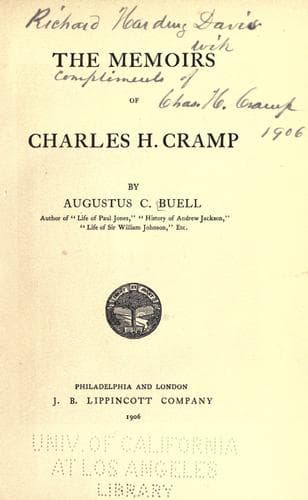
Cramp, Charles Henry, 1828-1913; Naval architects -- United States -- Biography
Early Ship-building in Philadelphia and Colonies—Paul Jones—Joshua
Humphreys—“Alliance”—Truxtun—Embargo—Decade following War of
1815—“Rebecca Sims”—Inauguration of Packet Lines—Thomas P. Cope—Decay
of Eastern Trade in Philadelphia—Auction Sales of Cargoes.
THE historical value of the character and career of individuals must be
rated by their share in and impress upon the events of their time. This
is equally true of success and failure. For example, the most famous man
of modern time terminated his career in the most colossal failure known
to history,—Napoleon Bonaparte. Yet, if we judge by the interest the
civilized world takes in every shred of his history and by the perennial
halo that envelops his name, people do not think about either his
triumphs or his disasters, but fix their attention singly upon the
impress he made upon civilization.
On the other hand, George Washington ended his career in success and
glory. But few, except students and pedants, know much about Washington
beyond that he was the founder of a new nation and the Father of a new
country which a century after his death has become the most formidable
on earth.
Thus, in either case, whether of success or of failure, both gigantic,
mankind rates the importance of each by the impress he made upon the
events of his time and by its enduring character.
Viewed broadly, the Europe of to-day as compared with the Europe of 1775
is as completely the creation of the popular forces incarnated in
Napoleon Bonaparte, as the American Republic of to-day as compared with
the revolted Colonies of 1775 is the creation of the popular forces
whose exponent George Washington was. From this point of view, the fact
that one failed while the other succeeded in the personal sense cuts no
figure whatever.
[Illustration: CLIPPERSHIP MORNING LIGHT]
These observations, while they have none other than a general relation
to our immediate subject, are pertinent to the main thread of our theme.
The real test of greatness in an individual, and therefore of the
historical value of his character and career, being the impress he makes
upon the events of his time, it follows that, unless the mention of a
man’s name instantly suggests some great thing or things that he has
done, or in a masterful way has helped to do, that man was not great; he
made no impress upon his times, and his biography can possess no
historic value. But whenever the name of a man stands as the exponent of
some great thing done or as the symbol of notable achievement, then the
character and career of that man belong to history, and the obligation
devolves upon literature to suitably perpetuate his memory.
Public-domain text, read in full here on John Shaqi.
Reviews
Reviews
No reviews yet
Be the first to share your thoughts on this work.
Join the Discussion
Join the discussion
Sign in to leave a comment or review.
Sign InorCreate an account