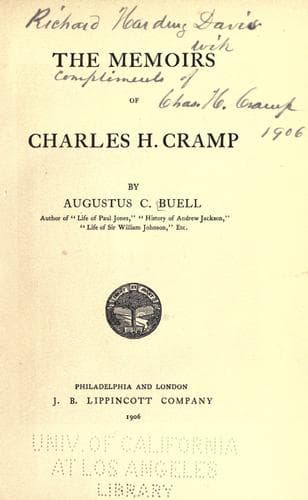
Cramp, Charles Henry, 1828-1913; Naval architects -- United States -- Biography
This, the prime test and condition of enduring fame, has been fulfilled
by the subject of this memoir, Charles Henry Cramp. Not alone in his own
country, but in Europe and Asia,—from St. Petersburg to Tokio,—the
mention of his name instantly suggests triumphs in the science of naval
architecture and marine engineering and successes in the art of building
ships. However, before proceeding to a history of the career and
life-work of Mr. Cramp himself, it seems proper to survey the historical
antecedents of his science and his art in his own field of action.
The art of naval architecture and the industry of ship-building were
almost coeval with the primitive establishment of the English-speaking
race on the American continent, and this was more particularly true of
Philadelphia than of any other place. In the earliest grants of land to
settlers, William Penn invariably included a clause requiring them, when
clearing the land granted, to “spare all smooth and large oak-trees
suitable for ship-timber.”
In 1685, three years after Penn arrived in the Colony, it was reported
to the Lords of Trade in London that “six ships capable of sea-voyage
and many boats have been built at Philadelphia.” From this early
beginning the industry grew rapidly, until in 1700 four yards were
engaged in building sea-going ships alone, besides several smaller
concerns which built fishing-boats and river-craft. Two rope-walks, two
or three block-makers’ shops, and several other special manufactories of
ship-building material, had been put in operation. At first the
spar-iron work needed was brought from England, but by the beginning of
the eighteenth century all the ship-smithing required for
Philadelphia-built ships was done on the spot.
The first four yards were located at different points along the beach,
between the foot of Market Street and the foot of Vine Street, and there
they remained until about the middle of the eighteenth century. By that
time the value of that part of the river front for commercial wharf
purposes had increased to such an extent that the ship-building industry
could not afford to hold it. In the meantime new yards had been
established down as far as South Street, others as far north as the
present foot of Fairmount Avenue. Obedient to this law of trade the four
older yards moved their plants either northward or southward, as
convenience or economy might dictate. But after 1744 no ships were built
between Market and Vine Streets. The last of these original shipyards of
Penn’s time to succumb was the largest and most important one in
Philadelphia. It was owned and managed by Mr. West, who was at that time
the leading ship-builder in the Colonies; and the ground his shipyard
occupied had been deeded to him by William Penn in part payment for a
ship he had built for Penn several years before. He removed to the
present foot of Green Street.
Public-domain text, read in full here on John Shaqi.
Reviews
Reviews
No reviews yet
Be the first to share your thoughts on this work.
Join the Discussion
Join the discussion
Sign in to leave a comment or review.
Sign InorCreate an account