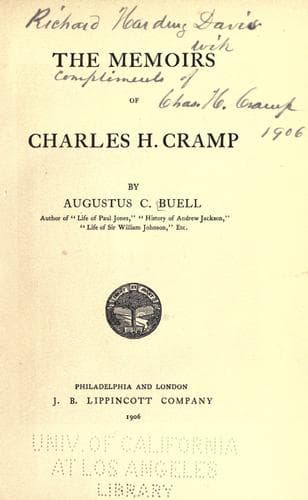
Cramp, Charles Henry, 1828-1913; Naval architects -- United States -- Biography
Naturally, such organizations, so led, fall easy dupes to the wiles of
the alien ship-owners, who have never left any stone unturned or any
expedient untried to defeat or smother in our own Congress legislation
calculated to promote and extend our merchant marine.
Whatever the distant future may bring forth, there seems to be at this
time and for the near future as little prospect of the development of a
new and purely American merchant marine in the foreign trade as there
has been at any time since the old one was destroyed.
Whatever may be the fate of the American merchant marine, it cannot be
said that during the campaign for its resurrection, lasting almost
continuously for over thirty years, Mr. Cramp has ever withheld from its
advocacy any part of his knowledge, study, observation, and experience;
and if, partly through the feebleness of our own patriotism in
legislation and administration, and partly through the superior and more
aggressive patriotism of foreign ship-owners and ship-builders, the
American merchant marine should become extinct, it will not be his
fault.
------------------------------------------------------------------------
CHAPTER IV
Condition of Navy after Civil War—Admiral Case’s Fleet—“Virginius’s”
Scare—“Huron,” “Alert,” and “Ranger”—Secretary Hunt—First Advisory
Board—Secretary Chandler—“Puritan” Class—Finished—Steel—Hon. J. B.
McCreary and Appropriation Bill for New Navy—Members of Second Naval
Advisory Board—Standard for Steel for New Ships, “Chicago,” “Boston,”
“Atlanta,” and “Dolphin”—Secretary Whitney—Beginning of New Navy, by
Charles H. Cramp—“Baltimore,” “Charleston,” and “Yorktown”—Purchase of
Drawings by Navy Department—Commodore Walker—Premium System—Mr.
Whitney’s Views—Premiums Paid—Attack on System—Secretary Tracy—War
College Paper—Classifying Bids.
AFTER the Civil War the navy was neglected, being, so far as its
cruising vessels were concerned, a wooden navy of not only obsolete
types, but decayed or decaying vessels, which gradually became a
reproach to the country and a laughing-stock for other maritime powers.
Public-domain text, read in full here on John Shaqi.
Reviews
Reviews
No reviews yet
Be the first to share your thoughts on this work.
Elsewhere in the archive
Join the Discussion
Join the discussion
Sign in to leave a comment or review.
Sign InorCreate an account