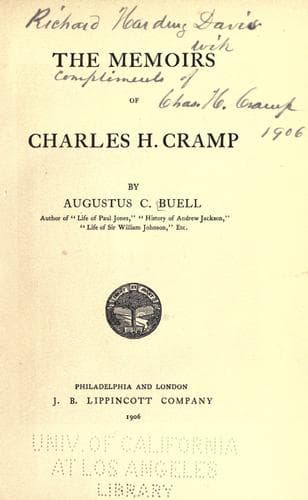
Cramp, Charles Henry, 1828-1913; Naval architects -- United States -- Biography
With this exception, nothing whatever was done toward increase or
betterment of our naval force from 1865 until 1883. However, in 1881,
General Garfield, having been elected President the preceding year and
inaugurated the 4th of March, 1881, appointed Judge William H. Hunt, of
Louisiana, Secretary of the Navy. General Garfield understood the naval
needs of the country, referred to the subject vigorously in his
inaugural, and quite early in his administration, or about a month
before he was assassinated, prompted his Secretary of the Navy to take
measures looking to the modernization of our national marine. The result
of this was the convening of a board early in the summer of 1881, of
which Admiral John Rodgers was President. The instructions of this board
were to investigate the existing state of foreign navies, to inquire
into the immediate needs of our own, and to formulate a ship-building
programme on modern lines, to be carried out as soon as the resources of
the country would permit. On the 7th of November, 1881, this board,
which is commonly known to history as the “First Naval Advisory Board,”
reported in accordance with its instructions. It is not necessary here
to go into detail with regard to the ship-building programme which they
recommended. Suffice to say, that not one of the ships or types of ships
which they recommended was ever actually built; but their deliberations
and report attracted general public attention, caused the subject to be
widely and patriotically, although not very intelligently, discussed in
the newspapers, so that, while the action of this first Naval Advisory
Board did not produce any actual or visible results, it at least served
to popularize the subject of the “New Navy.”
[Illustration: BATTLESHIP MAINE]
In 1882, Mr. Hunt was appointed Minister to Russia, and was succeeded in
the Secretaryship of the Navy by William E. Chandler, of New Hampshire.
Mr. Chandler was a vigorous, active man, and lost no time in taking
advantage of the public interest which had been aroused. The result of
the further investigations and reports which he caused to be made, and
his communications to the President, and through the President to
Congress based thereon, resulted in an act, approved March 3, 1883,
providing for the construction of four new cruising vessels, and the
launching and engining of the four double-turreted monitors “Puritan,”
“Terror,” “Amphitrite,” and “Monadnock,” which at that time had been on
the stocks about eight years. These were built of iron, and took the
places in the Navy Register of the worthless wooden monitors of the same
names.
Public-domain text, read in full here on John Shaqi.
Reviews
Reviews
No reviews yet
Be the first to share your thoughts on this work.
Elsewhere in the archive
Join the Discussion
Join the discussion
Sign in to leave a comment or review.
Sign InorCreate an account