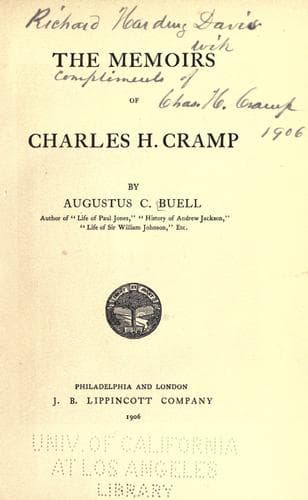
Cramp, Charles Henry, 1828-1913; Naval architects -- United States -- Biography
On the first lot of new vessels and engines, the bids were all
considerably below the cost estimated by the Advisory Board and the
Bureaus, and the contracts were let as follows: For the four vessels,
and the engines of the “Puritan,” monitor, to Mr. John Roach; for the
engines of the “Terror,” monitor, to William Cramp & Sons; and for the
“Amphitrite,” monitor, to the Harlan & Hollingsworth Company, of
Wilmington, Delaware. Work under all these contracts proceeded with
commendable alacrity.
Considerable difficulty was at first experienced in procuring material
for the new steel ships. The standard established by law was very high,
and the methods of test devised by the board, to say the least, did
nothing to ameliorate the rigors of the statute. The steel-makers,
however, bravely persevered, and finally overcame their difficulties in
the main, though a historical _résumé_ of the progress of the new navy
would be incomplete without the statement that none of the contractors,
under the Act of March 2, 1883, made any money, and some of them
suffered serious loss; and this statement applies equally to the
manufacturers who made the steel for the pioneer ships,—at least one old
and well established concern being wrecked by the difficulties
encountered, while others were embarrassed.
The year 1884 was signalized by a Presidential campaign of unusual
bitterness, and, notwithstanding the cordiality with which all parties
had joined hands in the inception of the new navy, the first session of
the Forty-eighth Congress developed what for a time threatened to be at
least a temporary hiatus. But wiser counsels at length prevailed, and,
though no additions were made to the list of new ships authorized,
sufficient appropriations were made to prevent stoppage of work on those
already under contract.
Public-domain text, read in full here on John Shaqi.
Reviews
Reviews
No reviews yet
Be the first to share your thoughts on this work.
Elsewhere in the archive
Join the Discussion
Join the discussion
Sign in to leave a comment or review.
Sign InorCreate an account