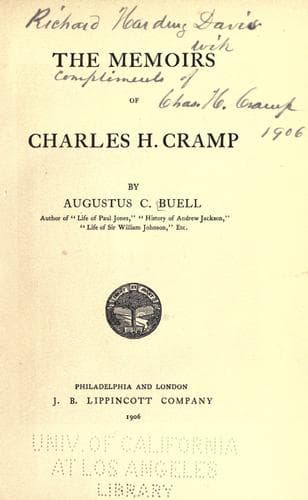
Cramp, Charles Henry, 1828-1913; Naval architects -- United States -- Biography
It is hard to overestimate the value of this ruling to the interests of
the new navy. Every one familiar with legislative processes knows the
advantage which appertains to the “right of way” enjoyed by a regular
appropriation bill as compared with the average chances of an
independent measure. These advantages are so marked, that it is quite
proper to say that Mr. McCreary’s rule on this point was of greater
importance than any other single incident in the legislative history of
naval reconstruction. In the Act of March 3, 1885, appeared another
clause prohibiting the repair of any existing wooden vessel when the
cost of such repair should exceed 20 per cent. upon the whole cost of
such vessel entirely new. This clause was adopted upon the
recommendation of Secretary Chandler, made in the previous year; its
obvious object being to render impossible the perpetuation of the old
and obsolete wooden ships. Its effect soon became apparent in a rapid
elimination of old wooden vessels from the navy, until by 1890 only
sixteen of them remained on the active list, and nearly, if not quite,
every one of these was then in her last commission. It is impossible to
overestimate the salutary effects of this clause. 1st. It “cleared the
decks” of a lot of obsolete lumber. 2d. It stimulated public opinion to
demand prompt production of new and modern ships to take the places of
the old and obsolete. 3d. It put an end to a policy of makeshifts which
was always extravagant, often wasteful, and sometimes corrupt.
The building of the four pioneer ships involved several new departures.
The Congress that authorized their construction and made an
appropriation toward it, also made provision for creating what was
termed a second “Naval Advisory Board,” which was to have charge of the
details of their building. By this expedient Congress hoped to avert the
evils of the Bureau system on the one hand, and to limit the one-man
power of the Secretary on the other. This board consisted of five
members, three naval officers and two civilians, to be selected by the
Secretary of the Navy. Of the two civilians, one was a ship-builder, the
other a mechanical engineer. The ship-builder was Henry Steers. This
gentleman was a nephew of George Steers, a somewhat celebrated naval
architect in his time, whose principal achievement was the design of the
yacht “America,” which won the cup which the English have struggled ever
since to recapture. The famous steam-frigate “Niagara,” built a short
time before the war, though constructed in a navy-yard, was designed by
Henry Steers. During the paralysis of American ship-building which
followed the Civil War, Mr. Steers became discouraged at the outlook
and, having a considerable fortune, went into the banking business.
Public-domain text, read in full here on John Shaqi.
Reviews
Reviews
No reviews yet
Be the first to share your thoughts on this work.
Elsewhere in the archive
Join the Discussion
Join the discussion
Sign in to leave a comment or review.
Sign InorCreate an account