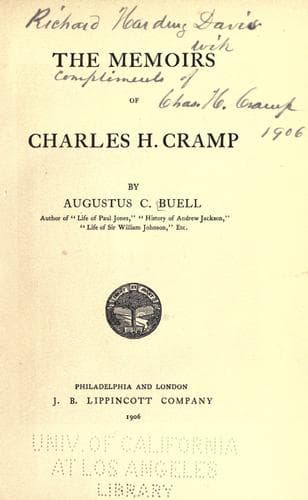
Cramp, Charles Henry, 1828-1913; Naval architects -- United States -- Biography
The other civilian member, the mechanical engineer, was Miers Coryell,
of New York. This gentleman was connected in his professional capacity
with the Cromwell Line of steamships plying between New York and New
Orleans. He had shortly before the time under consideration designed an
engine for the “Louisiana” of that line, which Mr. Roach built,
involving an entirely new departure in sea-going engine construction.
Perhaps the most concise way to describe this engine would be to say
that it represented an effort to introduce the walking-beam of a
side-wheel river steamboat into the engine compartment of a screw
steamship. The advantage claimed for it was that it permitted the use of
vertical cylinders within a deck-height not sufficient to admit the
regular type of vertical inverted cylinders. This it undoubtedly did;
but there its merit stopped. For the rest it was cumbrous, complicated,
and of weight exceedingly disproportionate to its power. This
unspeakable device Mr. Coryell offered to the Advisory Board, and, to
the speechless amazement of the engineering world, it was adopted as the
propelling machinery of the most important ship then authorized for the
navy. It is worthy of remark here that these beam-engines were
subsequently taken out of the “Chicago,” and a pair of vertical inverted
or slightly inclined engines of the usual type substituted. And it might
also be observed that this work, with some alterations in the hull, was
done in the New York Navy-Yard at a cost of $1,300,000 as against an
original contract price of $889,000 for the whole ship new; or, in other
words, the cost of re-engining and overhauling the “Chicago” in a
navy-yard was 40 per cent. more than the first cost of the new ship
under contract in a private shipyard!
The Navy Bureaus were not slow to discern what the creation of the
Advisory Board meant for them. At first they tried to defeat it. Finding
that impossible, two of the Bureau chiefs besought the Naval Committees
of the Senate and House to provide that at least one of the four ships
be built in a navy-yard. No member of the Senate committee favored this
proposition, and but two members of the House committee, both of whom,
it is hardly necessary to say, represented navy-yard districts and
danced to the music of labor agitators. Thus, at the inception of the
new navy the navy-yard snake was “scotched,” if not killed.
When the contracts and specifications were drawn up in form, two facts
became evident: One was that the knowledge of the new conditions of
naval construction possessed by the authorities of the navy itself was
altogether academic; and the other was that neither naval authorities
nor civilians interested had any adequate idea of what the requirement
of the law in regard to material actually signified. The law said that
the ships must be built of “steel, of domestic manufacture, having a
tensile strength of 60,000 pounds to the square inch, and an elongation
of 25 per cent. in eight inches.”
Public-domain text, read in full here on John Shaqi.
Reviews
Reviews
No reviews yet
Be the first to share your thoughts on this work.
Elsewhere in the archive
Join the Discussion
Join the discussion
Sign in to leave a comment or review.
Sign InorCreate an account