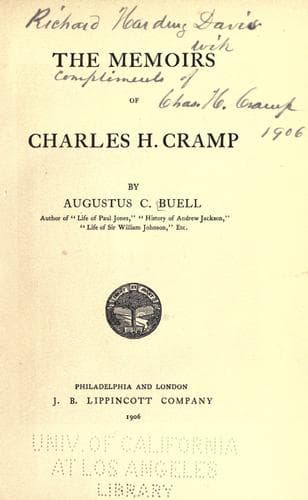
Cramp, Charles Henry, 1828-1913; Naval architects -- United States -- Biography
“It was more by good luck than by good management that Mr. Whitney
secured those particular drawings which proved to be of such
superior character. They were offered to our Naval Attaché, who
happened to be abroad in England at that time, by the Armstrong
Company. They had designed the two vessels which subsequently became
the ‘Baltimore’ and ‘Charleston’ of our navy. The design of the
‘Baltimore’ was made in competition with Thompson for the Spanish
government. For certain reasons, which I need not mention here, the
designs of Thompson were accepted and the contract for the
construction of the ship was awarded to them. She was known as the
‘Reina Regente.’ It was at this point that the Armstrongs presented
their rejected drawing and the drawings for the ‘Naniwa Khan’ for
sale to our Naval Attaché there. They had already built two vessels
like the ‘Naniwa Khan’ for the Japanese navy. These vessels were
looked upon by the experts of the naval world as being the two best
specimens of their type that had ever been built up to that time.
“At the time the sale was made, the Armstrongs, knowing nothing of
the capabilities of this country and having, like most British
ship-builders and many Americans at that time, a very mean and very
poor opinion of every ship-builder in this country, they suggested
that, in awarding the contract, a condition should be inserted
providing for the payment of superintendents whom they should send
over from their works to superintend the building, and designing of
the engines, and operating them after their completion. Considering
what to them appeared a barbarian incapacity on our part, they were
loath to risk their reputation without protection.
“We accepted the condition at the time, anxious to get the
contracts, feeling sure that it would never be needed, and that we
could prevail upon Mr. Whitney and the naval people as to the
impropriety of it.
“After the contract was awarded and the work was started, Mr.
Whitney concluded that, notwithstanding the provision was there, he
would never use it, and never require it of us.
“In fact, we made a great many improvements in the boilers of the
‘Baltimore,’ and some improvements in the engines. These
improvements in the boilers of the ‘Baltimore’ formed the basis and
the standard of construction of all the Scotch boilers that have
been built for the navy since that time.
“At the beginning of our work on these ships we did not get much
co-operation on the part of some of the Bureaus, in view of the
foreign character of most of the work, and in view, too, of the fact
that some of it was of our own, both being equally obnoxious, as
they originated outside of the Bureaus. We met with a great deal of
opposition at the beginning in getting up the specifications and
plans.
Public-domain text, read in full here on John Shaqi.
Reviews
Reviews
No reviews yet
Be the first to share your thoughts on this work.
Elsewhere in the archive
Join the Discussion
Join the discussion
Sign in to leave a comment or review.
Sign InorCreate an account