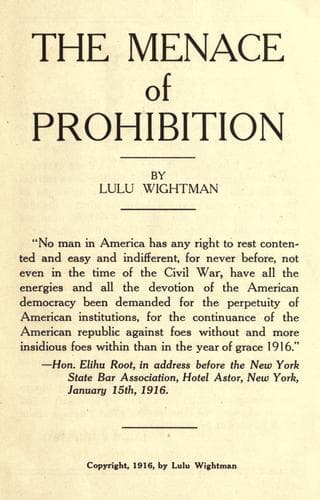
Prohibition -- Moral and ethical aspects; Prohibition -- United States
"Permit me, in this connection, to call attention to a most remarkable
fact; namely, that the people in many cases =actually vote to enslave
themselves=. History tells us of despots who kept their subjects in
perpetual serfdom, and of rulers who robbed the people of their freedom;
but there is no case on record, so far as we know, where the people of
their own volition and by their own votes robbed themselves of their own
birthright. The United States is the first example of this kind. The
history of the human race is =a constant struggle for liberty=, and every
concession wrung from the oppressors was heralded as a new triumph of
progress and civilization. Here we have the example of a generation
which, though being free, =voluntarily surrenders its social liberty and
forges with its own hands the fetters of slavery=. Now, can you account
for that? Is it because we do not sufficiently appreciate our heritage
on the theory that what you inherit and what comes to you easily you do
not value as what you have to fight for yourselves? Or is it because the
people do not fully realize just what they are doing =by joining forces
with those who are conspiring against their highest interests=? I leave
these questions for you to answer. Perhaps we are guilty on both
counts."
If the writer were to answer these questions, she would be constrained
to say that the last count is the strongest count: the people do not
realize what they are doing =by joining forces with those who are
conspiring against their highest interests=. The average American has
become a chronic joiner. He does not stand for something: he must belong
to something. The Prohibition movement comes along and appeals to his
sentimental and emotional nature. He has been schooled to depend
largely on sentiment, and trained to march with the crowd. To act as a
responsible unit has been practically impossible. He has never thought
upon the question deeply; he has been part of a muddled mass of
humanity, thinking as the mass thought and acting as they acted: he has
not been the soul-free individual he imagined himself to be; his acts
and opinions have been nothing more than weak reflections of the
opinions and acts of the muddled mass. He joins the Prohibition forces,
and thereafter thinks less than before, because, being joined to
something, he can safely trust to that something--the organized mass
which, in turn, thinks and acts just as a few self-appointed and
ambitious leaders think and act. There is no more for him to do now than
to walk up to the polls and vote precisely as he is bidden to do. He has
become a real automaton.
Public-domain text, read in full here on John Shaqi.
Reviews
Reviews
No reviews yet
Be the first to share your thoughts on this work.
Join the Discussion
Join the discussion
Sign in to leave a comment or review.
Sign InorCreate an account