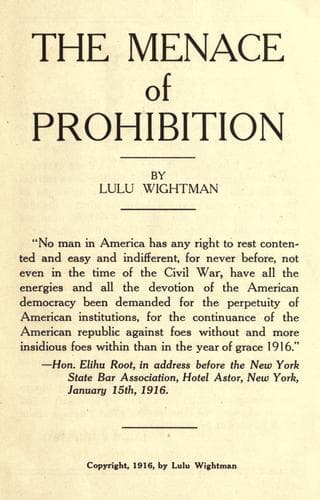
Prohibition -- Moral and ethical aspects; Prohibition -- United States
Carroll D. Wright, in the "Eighteenth Annual Report of the Commission of
Labor," shows that only one-fourth of one per cent of all cases of
non-employment in the United States is due to intemperance.
During the winter months of 1913-14, the number of unemployed men and
women in the United States was appalling. New York, Chicago, San
Francisco, and the large cities, were taxed to the utmost to care for
the "jobless."
It was estimated that New York City had its quota of 400,000 idle,
Chicago 200,000, San Francisco 30,000. Organized armies of the
unemployed clamored for work and for bread, and in the country districts
idle men were everywhere tramping to and fro in search of work. "THE
UNEMPLOYED" was a standing headliner of the public press. Suicides from
inability to find work were startlingly prevalent; and the whole country
was perplexed as to how to adjust complex conditions so as to relieve
untold suffering and misery.
Were the Prohibitionists on hand at that time with any sort of a
program, solution or panacea for the difficulty? Not at all. All their
efforts were reserved for election day; their energies stored up for the
glad time when well-paid agitators travel the country in Pullman cars to
tell the people of rural communities that "poverty is caused by drink."
Industrial Conditions Responsible
The fact of the matter is: that in the time when the situation of the
unemployed is most aggravated--when it attracts nation-wide
attention--singularly enough, no voice was raised, either by
individuals, societies, labor organizations, or the press, publicly,
attributing the abnormal and distressing conditions =to the drink habit=.
All these know better. They know, as the New York Association discovered
by its investigation, that inability to find work, and sickness, has
brought the great army of idle men and women to their plight. They know
that our productive ability is increasing much more rapidly than our
consumptive capacity, and that the statesmen-ship of this country as
well as that of every other country in the world is grappling not with
any merely individual or national, but with a world problem.
They know that in China, with its hundreds of millions of frugal,
temperate, hard-toiling people; in Turkey, with its sober, industrious,
Mahomet-worshiping masses; in India, with its almost countless
thousands, governed by strict religious, moral and ethical codes,--the
trouble is identical: =it is economic=. In the present industrial system
of those lands, as well as our own, there is no longer work enough for
all, not sufficient jobs for the number of toilers, and thus,
necessarily and unfortunately, there must be the great bodies of the
unemployed.
Public-domain text, read in full here on John Shaqi.
Reviews
Reviews
No reviews yet
Be the first to share your thoughts on this work.
Join the Discussion
Join the discussion
Sign in to leave a comment or review.
Sign InorCreate an account