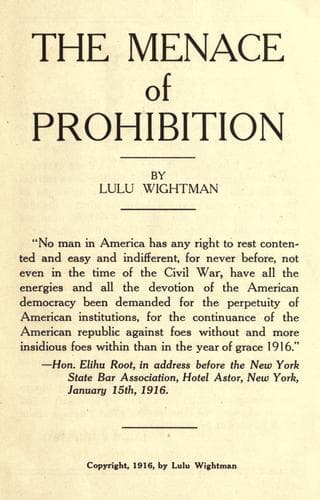
Prohibition -- Moral and ethical aspects; Prohibition -- United States
"Under laws prohibiting the liquor business we find the same results. In
the State of Maine, the oldest prohibition State in the Union, we find
more arrests for drunkenness, in proportion to the population, than in
any State where we have the licensed saloon.
"All Christian nations have for centuries accepted the prohibitory laws
of the ten commandments such as 'Thou Shalt Not Kill,' and yet it is the
same Christian nations that have the largest armies and navies, and that
have been doing nearly all the killing for thousands of years; likewise,
'Thou shalt not steal,' while today the most respected citizens of every
Christian nation in the world are, at the same time, the world's biggest
robbers.
"The power of government is limited when it comes to controlling or
regulating the thought of the individual, nor is it in the province of
government to say when, where, or what, citizens should eat, drink or
wear. The wisest government would promote conditions under which the
people would have plenty to eat, plenty to drink, plenty to wear and
good houses to live in. What he should eat and drink as well as the
amount and kind, or the color of the clothes he should wear, should be
the function of the individual."
Effects of Prohibition
The effect of Prohibition, sumptuary law enacted in government, upon the
political fabric of the government, should claim the serious attention
of American citizens particularly. We can hardly recur to the
consideration of this subject too often.
Prohibition is essentially a repressive measure, and all history shows
that repressive measures, under ordinary conditions, not only fail, but
worse than fail. In aiming to do away with one evil, Prohibitionists set
up a vastly greater one. In our American political life the very worst
political conditions may ensue.
Prohibition laws do not actually prohibit, as every one knows; but they
do bring about a state of affairs, upon whatever scale attempted,
abhorrent to every right-thinking person. As to some of the results,
Professor Hugo Munsterberg, of Harvard University, says:
"Judges know how rapidly the value of the oath sinks in courts where
=violation of the prohibition laws= is a frequent charge, and how habitual
perjury becomes tolerated by respectable people. The city politicians
know still better how closely blackmail and corruption hang together, in
the social psychology, with the enforcement of laws that strike against
the belief and traditions of wider circles. The public service becomes
degraded, the public conscience becomes dulled. And can there be any
doubt that disregard of laws is the most dangerous psychological factor
in our present-day American civilization."
And upon this question of the effectiveness of Prohibitory legislation,
and the effects of such legislation on the moral life of the nation, the
Committee of Fifty on the Physiological Aspects of the Liquor Problem in
its exhaustive report published in 1905, said:
Public-domain text, read in full here on John Shaqi.
Reviews
Reviews
No reviews yet
Be the first to share your thoughts on this work.
Join the Discussion
Join the discussion
Sign in to leave a comment or review.
Sign InorCreate an account