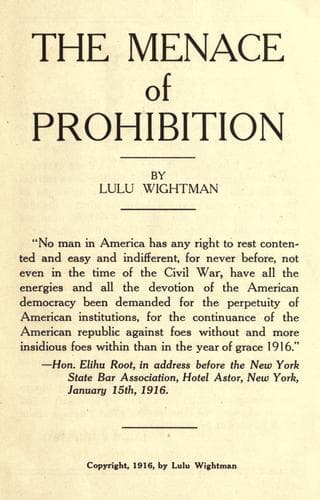
Prohibition -- Moral and ethical aspects; Prohibition -- United States
"There has been concurrent evil of prohibitory legislation. The efforts
to enforce it during forty years have had some unlooked-for effects on
public respect for courts, judicial proceedings, oaths and laws in
general, and for officers of the law, legislators and public
servants.... The public has seen law defied, a whole generation of
habitual law-breakers schooled in evasion and shamelessness, courts
ineffective through fluctuations of policy, delays, perjuries,
negligencies and other miscarriages of justice, officers of the law
double-faced and mercenary, legislators timid and insincere, candidates
for office hypocritical and truckling, and office-holders unfaithful to
pledges and public expectation. Through an agitation which has always
had a moral end, =these immoralities have been developed and made
conspicuous=."
Representative Claude U. Stone, of Illinois, in the debate in Congress
over the Hobson resolution for National Prohibition, said:
"There is State-wide prohibition in Maine, and the Webb-Kenyon law
prevents the overriding of that law by other States, and yet there are
cities in Maine that have more shops per capita for the public sale of
liquor than my home city, which is the greatest distilling city in the
world. In parts of Maine candidates for sheriff, who have the enforcing
of the law, =cannot be elected to office if they do not give a public
pledge that they will violate their oath of office and will not enforce
the laws=. The same can be said of Georgia, another prohibition State. It
is for this reason that the people should be permitted to determine by
their own votes the character of restraint that should be placed upon
themselves."
In the same debate in Congress, Representative Julius Kahn, of
California, remarked:
"Mr. Speaker, prohibition is not temperance. Temperance makes for human
progress. It should be invoked in regard to our food, our drink, our
dress, and even our physical exercise. As many people die from
overeating as die from excessive use of alcohol. Excessive physical
exercise has frequently led to heart failure and death. Temperance not
alone in the use of alcohol, but temperance in everything that affects
the human race, is what should be taught in the homes and schools of
this country. Temperance harms no one, on the contrary, it does good.
=Prohibition on the other hand, has generally resulted in making men
liars, sneaks and hypocrites.= If men want liquor, they can invariably
get it, and they can get it even in prohibition States."
Public-domain text, read in full here on John Shaqi.
Reviews
Reviews
No reviews yet
Be the first to share your thoughts on this work.
Join the Discussion
Join the discussion
Sign in to leave a comment or review.
Sign InorCreate an account