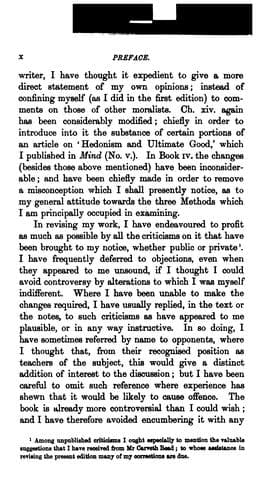
In revising my work, I have endeavoured to profit as much as possible
by all the criticisms on it that have been brought to my notice,
whether public or private.[4] I have frequently deferred to objections,
even when they appeared to me unsound, if I thought I could avoid
controversy by alterations to which I was myself indifferent. Where I
have been unable to make the changes required, I have usually replied,
in the text or the notes, to such criticisms as have appeared to me
plausible, or in any way instructive. In so doing, I have sometimes
referred by name to opponents, where I thought that, from their
recognised position as teachers of the subject, this would give a
distinct addition of interest to the discussion; but I have been
careful to omit such reference where experience has shown that it would
be likely to cause offence. The book is already more controversial
than I could wish; and I have therefore avoided encumbering it with
any polemics of purely personal interest. For this reason I have
generally left unnoticed such criticisms as have been due to mere
misapprehensions, against which I thought I could effectually
guard in the present edition. There is, however, one fundamental
misunderstanding, on which it seems desirable to say a few words.
I find that more than one critic has overlooked or disregarded the
account of the plan of my treatise, given in the original preface and
in § 5 of the introductory chapter: and has consequently supposed me
to be writing as an assailant of two of the methods which I chiefly
examine, and a defender of the third. Thus one of my reviewers seems
to regard Book iii. (on Intuitionism) as containing mere hostile
criticism from the outside: another has constructed an article on
the supposition that my principal object is the ‘suppression of
Egoism’: a third has gone to the length of a pamphlet under the
impression (apparently) that the ‘main argument’ of my treatise is
a demonstration of Universalistic Hedonism. I am concerned to have
caused so much misdirection of criticism: and I have carefully altered
in this edition the passages which I perceive to have contributed to
it. The morality that I examine in Book iii. is my own morality as
much as it is any man’s: it is, as I say, the ‘Morality of Common
Sense,’ which I only attempt to represent in so far as I share it; I
only place myself outside it either (1) temporarily, for the purpose
of impartial criticism, or (2) in so far as I am forced beyond it by
a practical consciousness of its incompleteness. I have certainly
criticised this morality unsparingly: but I conceive myself to have
exposed with equal unreserve the defects and difficulties of the
hedonistic method (cf. especially chaps. iii., iv. of Book ii., and
chap. v. of Book iv.). And as regards the two hedonistic principles, I
do not hold the reasonableness of aiming at happiness generally with
any stronger conviction than I do that of aiming at one’s own. It was
Public-domain text, read in full here on John Shaqi.
Reviews
Reviews
No reviews yet
Be the first to share your thoughts on this work.
Join the Discussion
Join the discussion
Sign in to leave a comment or review.
Sign InorCreate an account