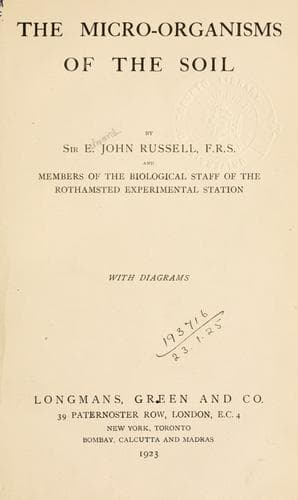
The micro-organisms of the soilRussell, Edward J. (Edward John)
Science
The micro-organisms of the soil
Russell, Edward J. (Edward John)
Soil microbiology
This conclusion aroused considerable controversy. It was maintained
that protozoa were not normal inhabitants of the soil, but only
occasional visitants, and, in any case, they were only there as cysts;
the soil conditions, it was urged, were not suitable to large organisms
like protozoa. The objection was not to be treated lightly, but, on
the other hand, the experiments seemed quite sound. As neither Dr.
Hutchinson nor the writer were protozoologists, Dr. T. Goodey and
(after he left) Mr. Kenneth R. Lewin were invited to try and find
out, quite independently of the partial sterilisation investigation,
whether protozoa are normal inhabitants of the soil, and if so, whether
they are in a trophic condition, and what is their mode of life and
their relation to soil bacteria. Had it turned out that protozoa had
nothing to do with the matter, search would have been made for some
other organism. Goodey showed that the ciliates were not particularly
important; Lewin soon demonstrated the existence of trophic amœbæ and
flagellates. Unfortunately he was killed in the war before he had got
far with the work. After the Armistice, Mr. Cutler accepted charge of
the work: he will himself relate in Chapters IV. and V. what he has
done.
At first sight it might be thought comparatively easy to settle a
question of this kind by examining soil under a microscope or by
sterilising it and introducing successively bacteria and known types
of protozoa. Unfortunately neither method is simple in practice. It
is impossible to look into the soil with a microscope, and methods of
teasing-out small pieces of soil on a slide under the high, or even the
low power, give no information, because the particles of soil have the
remarkable power of attracting and firmly retaining protozoa, and no
doubt bacteria as well; indeed, for protozoa (which have been the more
fully investigated) there seems to be something not unlike a saturation
capacity (see Fig. 9, p. 78). Further, complete sterilisation of soil
cannot be effected without at the same time altering its chemical and
physical properties, and changing it as a habitat for micro-organisms.
Cutler has, however, overcome the difficulties and shown that the
introduction of protozoa into soils sterilised and then reinfected with
bacteria considerably reduces the numbers of these organisms.
The method adopted, therefore, is to take a census of population and
of production. Counting methods are elaborated, and estimates as
accurate as possible are made of the numbers of the various organisms
in a natural field soil at stated intervals. Simultaneously, wherever
possible some measure is taken of the work done. The details of the
census are finally arranged in consultation with the Statistical
Department, to ensure that the data shall possess adequate statistical
value. From the results it is possible to adduce information of great
value as to the life of the population, the influence of external
conditions, etc.
Public-domain text, read in full here on John Shaqi.
Reviews
Reviews
No reviews yet
Be the first to share your thoughts on this work.
Join the Discussion
Join the discussion
Sign in to leave a comment or review.
Sign InorCreate an account