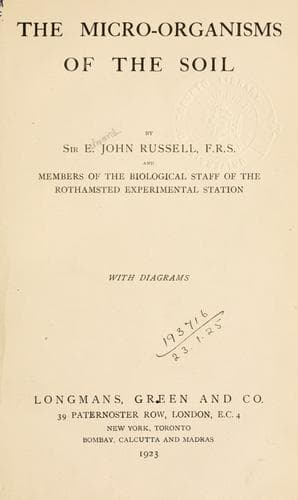
The micro-organisms of the soilRussell, Edward J. (Edward John)
Science
The micro-organisms of the soil
Russell, Edward J. (Edward John)
Soil microbiology
This was the condition of the subject when it was seriously taken up at
Rothamsted. Before turning to agriculture, the writer had been studying
the mechanism of certain slow chemical oxidations, and one of his first
experiments in agriculture was to examine the phenomena of oxidation
in soil. The results accorded with the biological explanation of
Schloesing: when the soil was completely sterilised oxidation almost
ceased. But the striking discovery was made, as the result of an
accident to an autoclave, that partial sterilisation increased the
rate of oxidation, and therefore presumably the bacterial activity.
This remarkable phenomenon had, however, already been observed, and
it had been shown that both bacterial numbers and soil fertility
were increased thereby. A full investigation was started in 1907 by
Dr. Hutchinson and the writer.[9] From the outset the phenomena were
recognised as dynamic and not static, and the rates of change were
always determined: thus the bacterial numbers, the nitrate and ammonia
present were estimated after the several periods. Close study of the
curves showed that the chemical and bacterial changes were sufficiently
alike to justify the view that bacteria were in the main the causes
of the production of ammonia and of nitrate; although non-biological
chemical action was not excluded, there was no evidence that it played
any great part. Thus the importance of micro-organisms in the soil was
demonstrated.
The factor causing the increased bacterial numbers after partial
sterilisation was studied by finding out what agents would, and what
would not, allow the numbers to increase, e.g. it was found that the
bacterial increases became possible when soil had been heated at 56°
C., but not at 40° C. Again, it was shown that the high numbers in
partially sterilised soils rose for a time even higher if a little
fresh untreated soil were incorporated into the partially sterilised
soil, but afterwards they fell considerably. Putting all the results
together, it appeared that some biological cause was at work depressing
the numbers of bacteria in normal soils, but not--or not so much--in
the partially sterilised soils. Studied in detail, the data suggested
protozoa as the agent keeping down bacterial numbers, and they were
found in the untreated, but not in the treated, soils. The hypothesis
was therefore put forward that bacteria are not the only members of the
soil population, but that protozoa are also present keeping them in
check, and therefore adversely affecting the production of plant food.
Public-domain text, read in full here on John Shaqi.
Reviews
Reviews
No reviews yet
Be the first to share your thoughts on this work.
Join the Discussion
Join the discussion
Sign in to leave a comment or review.
Sign InorCreate an account