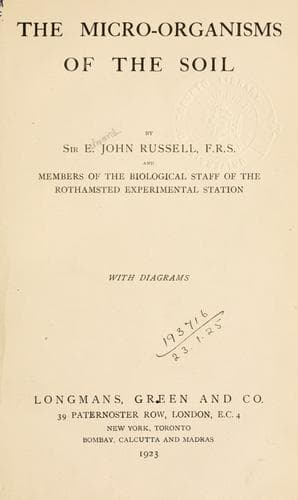
The micro-organisms of the soilRussell, Edward J. (Edward John)
Science
The micro-organisms of the soil
Russell, Edward J. (Edward John)
Soil microbiology
In the welter of scattered observations on the utilisation of
nitrogenous compounds, it is difficult to trace any clear issue. That
proteins, amino-acids, and other complex organic compounds are readily
broken down to ammonia by soil fungi is clear, and, on the other hand,
it is also clear that soil fungi utilise extensively ammonia and
nitrates as sources of nitrogen. On which side the balance lies it is
yet impossible to say.
MINERAL RELATIONSHIPS.
Heinze[27] and Hagem[26] have stated that soil fungi make the insoluble
calcium, phosphorus, and magnesium compounds in soil soluble and
available for plant food; and Butkevitch[12] has used _Aspergillus
niger_ in determining the availability of the mineral constituents,
but practically no work has yet been carried out on these problems.
A further matter on which sound evidence is greatly to be desired is
the part played by soil fungi in the oxidation processes of iron and
sulphur.
A point which may be mentioned here, as it is of some considerable
practical importance, is the large quantity of oxalic, citric, and
other acids formed by certain common soil fungi. Acid formation
is partly dependent upon the species of fungus--even more the
physiological race within the species--and partly upon the substratum,
particularly the source of carbon.[5],[54] It is interesting that as
a group _Actinomycetes_ do not form acids from the carbon source but
alkaline substances from the nitrogen sources.[69]
CONTROL OF SOIL FUNGI.
In the preceding sections an attempt has been made to sketch rapidly
the chief outlines of the widespread relationships of soil fungi and
of the fundamental part that they play in the biochemical changes
occurring in the soil. It will be evident, even from this survey,
that their occurrence is of the utmost agricultural importance, both
when helpful as in mycorrhizal relationships or as agents in making
complex organic materials available as plant food, or when harmful
as when causal agents of disease in plants. It is clear that could
the soil fungi be controlled to human ends by the encouragement of
the useful forms and the elimination of the harmful, a valuable power
would be placed in the hands of the grower of plants. Certain aspects
of this control, the cruder and more destructive perhaps, are already
practicable, whilst the finer and more constructive aspects remain
possibilities of to-morrow.
Public-domain text, read in full here on John Shaqi.
Reviews
Reviews
No reviews yet
Be the first to share your thoughts on this work.
Elsewhere in the archive
Join the Discussion
Join the discussion
Sign in to leave a comment or review.
Sign InorCreate an account