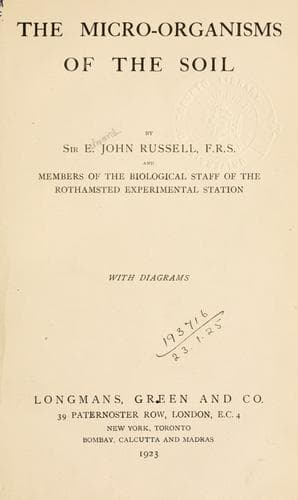
The micro-organisms of the soilRussell, Edward J. (Edward John)
Science
The micro-organisms of the soil
Russell, Edward J. (Edward John)
Soil microbiology
Theoretically, the technique of control is selective in that it aims
to determine one or more particular fungi, leaving the remaining flora
untouched. Its highest expression is seen, perhaps, in the utilisation
of pure cultures of mycorrhizal fungi for horticultural purposes, such
as orchid cultivation, but there is no reason why this should not be
done for other purposes on a field scale similar to the way in which
cultures of special strains of the root nodule organisms of legumes
are employed. A second aspect is the direct encouragement of special
components of the fungus flora for particular purposes by selective
feeding. Thus, in a laboratory experiment, McBeth and Scales[43] record
an increase of 2000 times in cellulose-destroying and other soil fungi
by this method. It has been pointed out that soil fungus activities
such as ammonification, proteolysis and carbohydrate decomposition are
controlled by factorial equilibria, and for special purposes it would
seem feasible to weight the balance so that particular activities may
be favoured. A further step in this direction is the controlling of
particular physical conditions so that the activities of certain fungi
may be restricted. Professor L. R. Jones[30] and his colleagues at
Madison have shown the primary importance of the control of the soil
temperature in certain parasitic relationships; the work of Gillespie
and Hurst[25] and later workers has demonstrated that the parasitism
of certain species and strains of _Actinomyces_ upon the potato
is conditioned by definite ranges of soil acidity; and many other
relationships of similar nature are known. Data along such lines are
rapidly accumulating, and in certain cases are already susceptible of
practical application. In other cases, particular soil fungi are less
open to persuasive influences, and more drastic treatment needs to be
adopted. Certain chemicals mixed intimately with the soil increase or
diminish the numbers of particular fungi or groups of fungi; whilst
these organisms may be totally eliminated from the soil by wet or
dry heat for definite periods or by treatment with potent fungicides
such as formaldehyde. Although soil sterilisation and crude treatment
in other ways has been practised for decades, the possibility of a
more delicate control of soil fungi is only now being realised. Its
concrete expression will depend upon the progress that is made in exact
knowledge of the activities of soil fungi under natural and controlled
conditions, of the balance of factors in the environment which controls
any particular function and of the genetic nature of the soil fungi
which occur. Each of these aspects is a fruitful field of study.
RELATION TO SOIL FERTILITY.
Public-domain text, read in full here on John Shaqi.
Reviews
Reviews
No reviews yet
Be the first to share your thoughts on this work.
Elsewhere in the archive
Join the Discussion
Join the discussion
Sign in to leave a comment or review.
Sign InorCreate an account