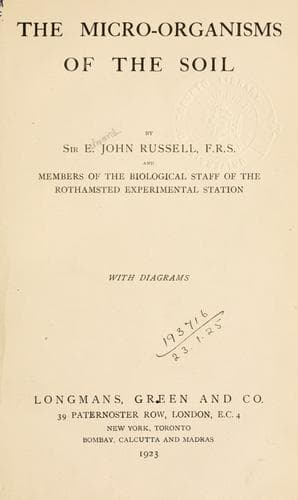
The micro-organisms of the soilRussell, Edward J. (Edward John)
Science
The micro-organisms of the soil
Russell, Edward J. (Edward John)
Soil microbiology
The nitrate content of the soil was simultaneously determined by Mr.
Page and found to vary from hour to hour, but the variations did not
sharply correspond with the bacterial numbers; this, however, would not
necessarily be expected. The production of nitrate involves various
stages, and any lag would throw the nitrate and bacterial curves out
of agreement. There is a suggestion of a lag, but more counts are
necessary before it can be regarded as established.
Examination of these and other nitrate curves obtained at Rothamsted
has brought out another remarkable phenomenon. No crop is growing on
these plots, and no rain fell during the eighty hours, yet nitrate
is disappearing for a considerable part of the time. Where is it
going to? At present the simplest explanation seems to be that it is
taken up by micro-organisms. A similar conclusion had to be drawn
from a study of the nitrogen exhaustion of the soil. The whole of the
nitrate theoretically obtainable from the organic matter of the soil
is not obtained in the course of hours or even days; in one of our
experiments at Rothamsted nitrification is still going on, and is far
from complete, even after a lapse of fifty-three years. The explanation
at present offered is that part of the nitrate is constantly being
absorbed by micro-organisms and regenerated later on.
Now what organisms could be supposed to absorb nitrates from the soil?
Certain bacteria and fungi are known to utilise nitrates, and one
naturally thinks of algæ as possible agents also. Dr. Muriel Bristol
was therefore invited to study the algæ of the soil. Her account is
given in Chapter VI. She has found them not only on the surface, but
scattered throughout the body of the soil, even in the darkness of 4
inches, 5 inches, or 6 inches depth, where no light can ever penetrate,
and where photosynthesis as we understand it could not possibly take
place. Some modification in their mode of life is clearly necessary,
and it may well happen that they are living saprophytically. Dr.
Bristol has not yet, however, been able to count the algæ in the soil
with any certainty, although she has made some estimates of the numbers.
The quantitative work on the soil population indicates other
possibilities which are being investigated. There is not only a daily
fluctuation in the numbers, but so far as measurements have gone,
a seasonal one also. There seems to be some considerable uplift in
numbers of bacteria, protozoa, and possibly algæ and fungi in the
spring-time, followed by a fall in summer, a rise in autumn, and a
fall again in winter. At present we are unable to account for the
phenomenon, nor can we be sure that it is general until many more data
are accumulated.
In the cases of the protozoa and the algæ, there was a definite reason
for seeking them in the soil.
Public-domain text, read in full here on John Shaqi.
Reviews
Reviews
No reviews yet
Be the first to share your thoughts on this work.
Join the Discussion
Join the discussion
Sign in to leave a comment or review.
Sign InorCreate an account