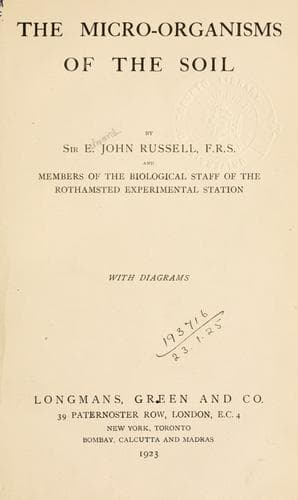
The micro-organisms of the soilRussell, Edward J. (Edward John)
Science
The micro-organisms of the soil
Russell, Edward J. (Edward John)
Soil microbiology
Another section of the population, the fungi, was simply found, and
at present we have only limited views as to their function. The older
workers considered that they predominated in acid soils, while bacteria
predominated in neutral soils. Present-day workers have shown that
fungi, including actinomycetes, are normal inhabitants of all soils.
The attempts at quantitative estimations are seriously complicated
by the fact that during the manipulations a single piece of mycelium
may break into fragments, each of which would count as one, while a
single cluster of spores might be counted as thousands. Little progress
has therefore been made on the quantitative lines which have been so
fruitful with protozoa. Dr. Brierley gives, in Chapters VII. and VIII.,
a critical account of the work done on fungi.
In addition to the organisms already considered there are others of
larger size. The nematodes are almost visible to the unaided eye,
most of them are free living and probably help in the disintegration
of plant residues, though a few are parasitic on living plants and do
much injury to clover, oats, and less frequently to onions, bulbs, and
potatoes. Further, there are insects, myriapods and others, the effects
of which in the soil are not fully known. Special importance attaches
to the earthworms, not only because they are the largest in size and
in aggregate weight of the soil population, but because of the great
part they play in aerating the soil, gradually turning it over and
bringing about an intimate admixture with dead plant residues, as first
demonstrated by Darwin. Earthworms are the great distributors of energy
material to the microscopic population. Systematic quantitative work
on these larger forms is only of recent date, and Dr. Imms, in Chapter
IX., discusses our present knowledge.
TABLE I.
SOIL POPULATION, ROTHAMSTED, 1922.
(The figures for algæ and fungi are first approximations only, and have
considerably less value than those for bacteria and protozoa.)
Public-domain text, read in full here on John Shaqi.
Reviews
Reviews
No reviews yet
Be the first to share your thoughts on this work.
Join the Discussion
Join the discussion
Sign in to leave a comment or review.
Sign InorCreate an account