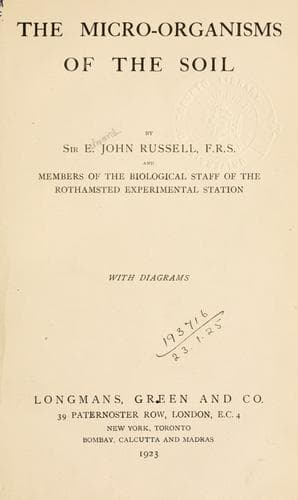
The micro-organisms of the soilRussell, Edward J. (Edward John)
Science
The micro-organisms of the soil
Russell, Edward J. (Edward John)
Soil microbiology
+--------------------------------------
| LARGER ORGANISMS.
+-----------------+-------------------+
| | |
| | +
| | Numbers |
| | per Acre.[D] |
| +---------+---------+
| | | Unma- |
| | Manured.| nured. |
+-----------------+---------+---------+
|_Oligochaeta_ | | |
| (_Limicolae_)--| | |
| Nematoda, etc. |3,609,000| 794,000|
| Myriapoda |1,781,000| 879,000|
| Insects |7,727,000|2,475,000|
| Earthworms |1,010,000| 458,000|
+-----------------+---------+---------+
|
+--------------------------------------
+-----------------------------------------------------------+
| LARGER ORGANISMS. |
+-----------------+-----------------------------------------+
| | Approximate Weight per Acre of-- |
| +-------------+-------------+-------------+
| | Living | Dry Matter | Nitrogen in |
| | Organisms. |in Organisms.| Organisms. |
| +------+------+------+------+------+------+
| | Ma- | Unma-| Ma- | Unma-| Ma- |Unma- |
| |nured.|nured.|nured.|nured.|nured.|nured.|
+-----------------+------+------+------+------+------+------+
|_Oligochaeta_ | | | | | | |
| (_Limicolae_)--| lb. | lb. | lb. | lb. | lb. | lb. |
| Nematoda, etc. | 9 | 2 | 3 | 1 | -- | -- |
| Myriapoda | 203 | 99 | 85 | 42 | 4 | 2 |
| Insects | 34 | 16 | 14 | 6 | 1 | 1 |
| Earthworms | 472 | 217 | 108 | 50 | 10 | 5 |
+-----------------+------+------+------+------+------+------+
| Total | 210 | 99 | 15 | 9 |
+-------------------------------+------+------+------+------+
Total organic matter (dry weight) in this soil = 126,000 lb. per acre.
Total nitrogen = 5700 lb. per acre. (1 lb. nitrogen per acre = 0·4
parts per 1,000,000 of soil.)
[D] To a depth of 9 inches. The weight of soil is approximately
1,000,000 kilos.
Are there any other members of the soil population that are of
importance? As already shown, the method of investigating the soil
population in use at Rothamsted is to find by chemical methods the
changes going on in the soil; to find by biological methods what
organisms are capable of bringing about these changes; and then to
complete the chain of evidence by tracing the relationships between
the numbers or activities of these organisms and the amount of change
produced. The list as we know it to-day is given in Table I.
Public-domain text, read in full here on John Shaqi.
Reviews
Reviews
No reviews yet
Be the first to share your thoughts on this work.
Join the Discussion
Join the discussion
Sign in to leave a comment or review.
Sign InorCreate an account