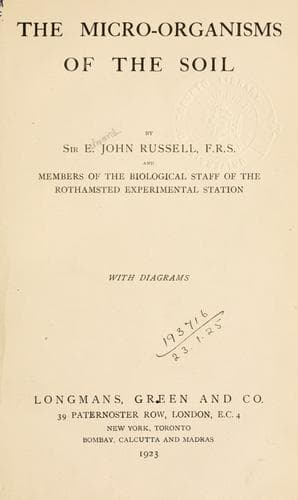
The micro-organisms of the soilRussell, Edward J. (Edward John)
Science
The micro-organisms of the soil
Russell, Edward J. (Edward John)
Soil microbiology
The method, however, does not indicate whether the account is fairly
complete, or whether there are other organisms to be found. We might,
of course, trust to empirical hunting for organisms, or to chance
discoveries such as led Goodey to find the mysterious Proteomyxan
Rhizopods, which cannot yet be cultured with certainty, so that they
are rarely found by soil workers. It is possible that there are many
such organisms, and it is even conceivable that these unknown forms far
outnumber the known. The defect of the present method is that it always
leaves us in doubt as to the completeness of the list, and so we may
have to devise another.
Reverting to Table I., it obviously serves no purpose to add the
numbers of all the organisms together. We can add up the weights of
living organisms, of their dry matter or nitrogen, so as to form some
idea of the proportion of living to non-living organic matter, and this
helps us to visualise the different groups and place them according
to their respective masses. But a much better basis for comparing the
activities of the different groups would be afforded by the respective
amounts of energy they transform, if these could be determined. It is
proposed to attempt such measurements at Rothamsted. The results when
added would give the sum of the energy changes effected by the soil
population as we know it: the figure could be compared with the total
energy change in the soil itself as determined in a calorimeter. If
the two figures are of the same order of magnitude, we shall know that
our list is fairly well complete; if they are widely different, search
must be made for the missing energy transformers. There are, of course,
serious experimental difficulties to be overcome, but we believe the
energy relationships will afford the best basis for further work on the
soil population.
Finally, it is necessary to refer to the physical conditions obtaining
in the soil. These make it a much better habitat for organisms than one
might expect. At first sight one thinks of the soil as a purely mineral
mass. This view is entirely incorrect. Soil contains a considerable
amount of plant residues, rich in energy, and of air and water. The
usual method of stating the composition of the soil is by weight, but
this is misleading to the biologist because the mineral matter has a
density some two and a half times that of water and three times that
of the organic matter. For biological purposes composition by volume
is much more useful, and when stated in this way the figures are very
different from those ordinarily given. Table II. gives the results for
two Broadbalk arable plots, one unmanured and the other dunged; it
includes also a pasture soil.
Public-domain text, read in full here on John Shaqi.
Reviews
Reviews
No reviews yet
Be the first to share your thoughts on this work.
Join the Discussion
Join the discussion
Sign in to leave a comment or review.
Sign InorCreate an account