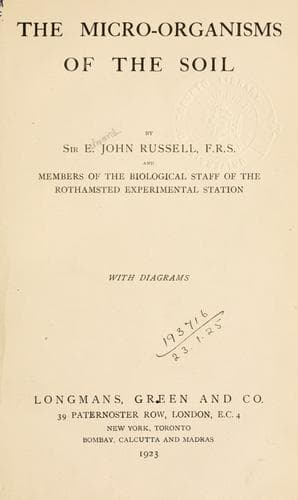
The micro-organisms of the soilRussell, Edward J. (Edward John)
Science
The micro-organisms of the soil
Russell, Edward J. (Edward John)
Soil microbiology
The inadequacy of mere morphology as a basis for describing bacteria
led to the search for diagnostic characters, based on the biochemical
changes that they produced in their culture media, and the appearance
of their growth in the mass on various media. These characters
unfortunately have also proved to be very much influenced by the exact
composition of the medium and other conditions of culture. Recently
an attempt has been made by the American Society of Bacteriologists to
standardise the diagnostic characters used in describing bacteria, and
also the media and cultural conditions under which they are grown for
the purpose of description. The need for such precautions, however,
was not sufficiently realised by the early workers, many of whose
descriptions cannot now be referred to any definite organism.
The large number of organisms found in the soil, and the difficulty
and labour of adequately describing them, is such that even now we
have no comprehensive description of the common soil bacteria that
appear on gelatine platings. A careful study based on modern methods of
characterisation has been made of certain selected groups of bacteria,
and it is hoped that the laborious systematic work of describing the
common forms will gradually be completed.
Several attempts have been made to classify the bacteria that appear
commonly on gelatine platings. This work was commenced by Hiltner and
Stormer in Germany, and continued by Chester, Harding, and Conn in
America. Conn[10],[14] found that the common organisms fell into the
following main groups:--
(1) Large spore-forming bacteria, related to _Bacillus subtilis_, which
form about 5-10 per cent. of the numbers. He adduced evidence[12],[13]
that these organisms exist in the soil mainly as spores, so that they
may not form an important part of the active soil population.
(2) Short non-sporing organisms, related to _Pseudomonas fluorescens_,
that are rapid gelatine liquefiers. These form another 10 per cent. of
the numbers.
(3) Short rod forms that liquefy gelatine slowly or not at all, and
develop colonies very slowly. These form 40-75 per cent. of the
numbers, and may therefore be of considerable importance in the soil.
(4) A few micrococci also occur.
These groups comprise the larger portion of the bacterial flora of the
soil, but, in addition to these organisms, that develop on the media
commonly used for plating, there are special and important groups
that appear only on special media, either owing to their being unable
to grow on ordinary media or because they get swamped by other forms.
Examples of such groups are the ammonia and nitrite oxidising bacteria,
the nitrogen fixing groups, the cellulose decomposing organisms, and
the sulphur bacteria.
Public-domain text, read in full here on John Shaqi.
Reviews
Reviews
No reviews yet
Be the first to share your thoughts on this work.
Join the Discussion
Join the discussion
Sign in to leave a comment or review.
Sign InorCreate an account