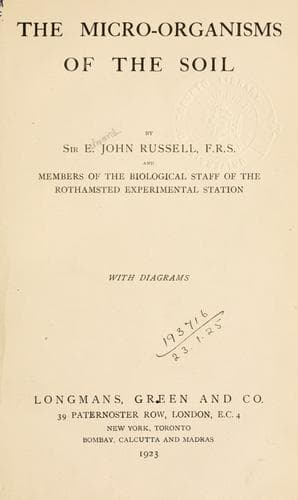
The micro-organisms of the soilRussell, Edward J. (Edward John)
Science
The micro-organisms of the soil
Russell, Edward J. (Edward John)
Soil microbiology
In order that we may apply the results of the study of a definite
organism to other localities, a knowledge of the geographical
distribution of the soil bacteria is clearly needed. We have,
unfortunately, very little knowledge of the distribution of soil
organisms. The common spore-forming groups appear to be universally
distributed. Thus Barthel, in a study of the bacterial flora of soils
from Greenland and the island of Disko, obtained soil organisms
belonging to the groups of _Bacillus subtilis_, _B. amylobacter_, _B.
fluorescens_, _B. caudatus_, and _B. Zopfii_, which are common groups
in European soil, indicating that the general constitution of the
bacterial flora of the soil in arctic regions is not widely different
from that of Western Europe. Bredemann, who made an extensive study of
the _Bacillus amylobacter_ group, obtained soil samples from widely
scattered localities, and found these organisms in soil from Germany,
Holstein, Norway, Italy, Morocco, Teneriffe, Russia, Japan, China,
the East Indies, Samoa, Illinois, Arizona, German East Africa, and
the Cameroons. Some soil organisms, on the other hand, are apparently
absent from certain districts. This may be due to the conditions,
such as climatic environment, being unfavourable to them. A study has
recently been made at Rothamsted of the distribution over Great Britain
of a group of bacteria that are capable of decomposing phenol and
cresol. One of these organisms, apparently related to the acid-fast
_B. phlœi_, has an interesting distribution. It has been found in 50
per cent. of the soils samples examined from the drier region, where
the annual rainfall is less than 30 inches, but in only 20 per cent.
of the samples in the wetter parts of Britain. Another example of
limited distribution is found in the case of _Bacillus radicicola_,
the organism that produces tubercles on the roots of leguminous plants.
The distribution of the varieties of this organism follows that of
the host plants with which they are associated, so that when a new
leguminous crop is introduced into a country, nodules may not appear
on the roots unless the soil be specially inoculated with the right
variety of organism. In cases where a group of soil organisms is widely
distributed over the globe, it may yet be absent from many soils
owing to the soil conditions not suiting it. Thus, phenol decomposing
bacteria, though abundant in the neighbourhood of Rothamsted, are yet
absent from field plots that have been unmanured for a considerable
period. The occurrence of the nitrifying organisms and the nitrogen
fixing _Azotobacter_ is also very dependent on the soil conditions.
Public-domain text, read in full here on John Shaqi.
Reviews
Reviews
No reviews yet
Be the first to share your thoughts on this work.
Join the Discussion
Join the discussion
Sign in to leave a comment or review.
Sign InorCreate an account