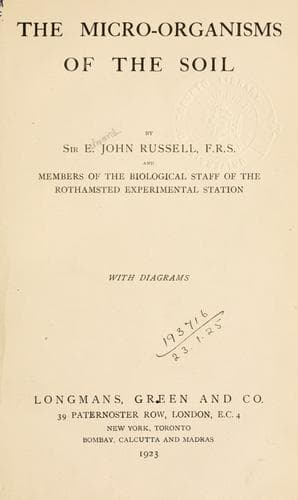
The micro-organisms of the soilRussell, Edward J. (Edward John)
Science
The micro-organisms of the soil
Russell, Edward J. (Edward John)
Soil microbiology
While cellulose and related carbohydrates are by far the most
important non-nitrogenous compounds left in the soil by plants, there
are other compounds whose destruction by bacteria is of special
interest. Such, for example, is the case of phenol. This compound is
produced by bacterial action as a decomposition product of certain
amino-acids. It occurs in appreciable amounts in cow urine. It is
probable that it forms a common decomposition product in soil and
also in farmyard manure. If this phenol were to persist in the soil,
it would eventually reach a concentration harmful to plant growth. It
does not, however, accumulate in the soil; indeed, if pure phenol or
cresol be added to ordinary arable soil, a rapid disappearance occurs.
This disappearance is of some practical importance, since it limits
the commercial use of these compounds as soil sterilising agents.
The cause of the disappearance has been to some extent elucidated at
Rothamsted,[58] where it was found to be in part a purely chemical
reaction with certain soil constituents, and partly due to the activity
of bacteria capable of decomposing it. A large number of soil bacteria
have now been isolated that can decompose phenol, meta-, para-, and
ortho-cresol, and are able to use these substances as the sole sources
of energy for their life processes. These organisms have a wide
distribution, having been found in soil samples taken from all over
Great Britain, from Norway, the Tyrol, Gough Island, Tristan da Cunha
and South Georgia. Soil bacteria have also been isolated that are able
to decompose and derive their energy from naphthalene and from toluene.
The ability of the bacteria to break up the naphthalene is very
remarkable, and all the more so since they can hardly have come across
this compound in the state of nature. The naphthalene organisms have a
distribution as world-wide as the phenol group.
(2) _Ammonia Production._
The second main group of products left in the soil by higher plants
are the nitrogen-containing compounds, such as the proteins and
amino-acids. Plant remains are not the only source of organic nitrogen
compounds available to soil bacteria. There are, in addition, the dead
bodies of other soil organisms, such as protozoa and algæ. The relative
importance of these sources of nitrogen is not known, but almost
certainly varies greatly with the state of activity of the various
groups of the soil population. Bacteria are able to utilise organic
nitrogen compounds as energy sources, as can be exemplified in the
oxidation of a simple amino-acid:--
H O
| //
H--C--C + 3O = 2CO₂ + H₂O + NH₃ + 152 Cal.
| \
NH₂ OH
Public-domain text, read in full here on John Shaqi.
Reviews
Reviews
No reviews yet
Be the first to share your thoughts on this work.
Join the Discussion
Join the discussion
Sign in to leave a comment or review.
Sign InorCreate an account