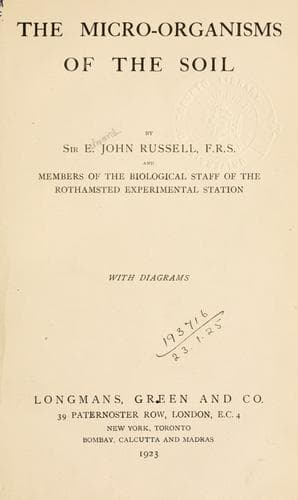
The micro-organisms of the soilRussell, Edward J. (Edward John)
Science
The micro-organisms of the soil
Russell, Edward J. (Edward John)
Soil microbiology
It is well known that if fresh unrotted manure or straw be added to
the soil, it often produces harmful effects on the succeeding crop.
The problem, therefore, was to develop a method by which fresh straw,
before application to the soil, could be made to rot down to a mixture
of humus compounds such as occur in well-rotted farmyard manure. The
solution of this problem came as a result of an investigation by
Hutchinson and Richards,[30_b_] at Rothamsted, into food requirements
of the cellulose decomposing bacteria. They realised that since more
than 10 per cent. of the dry weight of bacteria consists of nitrogen,
it would be necessary to supply the cellulose decomposing bacteria with
a supply of nitrogen, in order that they should attain their greatest
activity. Experiments with cultures of _Spirochæta cytophaga_ showed
that the amount of cellulose decomposed depended upon an adequate
supply of nitrogen for the organism (Fig. 3). Similarly, materials such
as straw will scarcely decompose at all if wetted with pure water. An
adequate supply of nitrogen compounds is needed to enable decomposition
to take place. Hutchinson and Richards tested the effect of ammonium
sulphate, and discovered experimentally the proportion of ammonia to
straw that produced the most rapid decomposition. They found that if
a straw heap was treated with the correct proportion of ammonia, it
decomposed into a brown substance having the appearance of well-rotted
manure. This has resulted in the development of a commercial process
for making synthetic farmyard manure from straw. The method of
manufacture is as follows: A straw stack is made and thoroughly wetted
with water. The correct amount of ammonium sulphate is then sprinkled
on the top and wetted, so that the solution percolates through the
straw. The cellulose bacteria attack the straw, breaking it down
and assimilating the ammonia. This ammonia is not wasted, as it is
converted into bacterial protoplasm that eventually decays in the soil.
Field trials of this synthetic manure show that it produces an effect
closely similar to that of natural farmyard manure.
Public-domain text, read in full here on John Shaqi.
Reviews
Reviews
No reviews yet
Be the first to share your thoughts on this work.
Join the Discussion
Join the discussion
Sign in to leave a comment or review.
Sign InorCreate an account