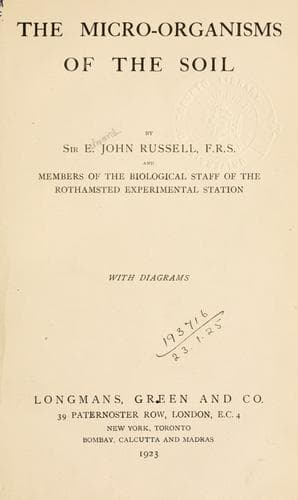
The micro-organisms of the soilRussell, Edward J. (Edward John)
Science
The micro-organisms of the soil
Russell, Edward J. (Edward John)
Soil microbiology
Under normal conditions of well aerated soil, however, it is unlikely
that the reduction of nitrate is of great importance. In such soils the
activities through which bacteria acquire their energy are, as we have
seen, of vital importance to the plant, resulting in the disintegration
of plant tissues, with the ultimate formation of humus, and in the
production of nitrate.
In their activities connected with the building up of their protoplasm,
bacteria may, on the other hand, compete with the plant. These
activities and their consequences will be reviewed in the following
chapter.
CHAPTER III.
SOIL BACTERIA.
_C._ ACTIVITIES CONNECTED WITH THE BUILDING-UP OF BACTERIAL PROTOPLASM.
(1) _Composition of Bacteria._
The activities of the soil bacteria that we have yet to consider are
those connected with the building-up from simpler materials of the
protoplasm of the bacterial cell. It is important to bear in mind that
this process is one requiring an expenditure of energy on the part of
the organism. The sources of energy we have already considered.
The bodies of bacteria contain the same elements common to other
living matter. Analyses of various bacteria have been made by a number
of workers. About 85 per cent. of their weight is made up of water.
This analysis of Pfeiffer’s Bacillus by Cramer[15] shows the typical
percentages of carbon, nitrogen, hydrogen, and ash in the dry matter:--
_Composition of Pfeiffer’s Bacillus (Cramer)._
C 50 per cent.
N 12·3 „
H 6·6 „
Ash 9·1 „
About 65-70 per cent. of the dry matter of bacteria consists of protein.
(2) _Sources of Carbon._
The biggest constituent of the dry matter of bacteria is therefore
carbon. In the soil, bacteria find an abundance of organic matter from
which they may derive their carbon supply. A special case, however,
is furnished by the nitrifying organisms, certain sulphur oxidising
bacteria, and others that derive their carbon from the CO₂ of the soil
atmosphere. The sources from which these special groups obtain the
necessary energy to accomplish this, we have already considered.
(3) _Assimilation of Nitrogen Compounds._
Of chief importance in its consequences are the means adopted by
bacteria to obtain their nitrogen supply.
There is some reason to believe that soil bacteria do not take up
protein and peptones as such, but must first break down these bodies
into simpler compounds. When a sufficient amount of easily decomposable
organic nitrogen is present in the soil, the ammonifying bacteria use
such compounds as sources of energy, and in this case have a nitrogen
supply exceeding their requirements.
Public-domain text, read in full here on John Shaqi.
Reviews
Reviews
No reviews yet
Be the first to share your thoughts on this work.
Join the Discussion
Join the discussion
Sign in to leave a comment or review.
Sign InorCreate an account