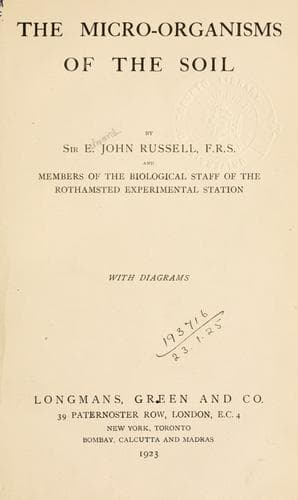
The micro-organisms of the soilRussell, Edward J. (Edward John)
Science
The micro-organisms of the soil
Russell, Edward J. (Edward John)
Soil microbiology
But where there is an excess of carbohydrate or other non-nitrogenous
source of energy available in the soil, the case is different. Here
the organisms have a supply of energy which enables them to multiply
rapidly until the organic nitrogen is insufficient for their needs.
Hence they turn to the ammonia and nitrate present in the soil, and
build up their proteins from this source. Doryland[17] has shown that
many common soil ammonifiers assimilate ammonia and nitrate when
supplied with carbohydrate. There may thus be a temporary loss of
nitrate from soil when sugar, starch, straw, or such materials are
added to it.
(4) _Fixation of Free Nitrogen._
The bacteria that we have so far considered take up their nitrogen
directly from compounds containing this element. There remain, however,
a comparatively small but very important group of bacteria possessing
the power of causing elemental nitrogen to combine, and of building it
up into their proteins. This fixation of nitrogen by micro-organisms
is a vital step in the economy of nature. Losses of nitrogen from the
land are continually occurring through the washing-out of nitrates
by rain, and through the evolution of gaseous nitrogen during the
processes of decay. To maintain the supply of combined nitrogen
which is essential to living organisms, there must therefore be a
compensating process by which the supply of nitrogen compounds in the
soil is kept up.
It was discovered in the middle of the nineteenth century that if soil
were kept moist and exposed to the air, there was an increase in the
amount of nitrogen compounds present. Berthelot, in 1893, studied the
nitrogen relationships of soil, and recognised that this fixation of
nitrogen in soil was the work of micro-organisms.
Winogradsky followed up his work and isolated from soil a large
anaerobic spore-forming organism, capable of fixing nitrogen, to which
he gave the name _Clostridium pasteurianum_. In 1901 the investigations
of Beyerinck, in Holland, led to the important discovery of a group of
large aerobic organisms, which he named _Azotobacter_. These were found
to be very active in fixing free nitrogen. More recently, a number of
other nitrogen-fixing bacteria have been described, and the property
has been found to exist to a small extent in several previously
well-known organisms.
It becomes important to determine which are the groups of bacteria
whose nitrogen-fixing powers are of chief importance in the soil.
Public-domain text, read in full here on John Shaqi.
Reviews
Reviews
No reviews yet
Be the first to share your thoughts on this work.
Join the Discussion
Join the discussion
Sign in to leave a comment or review.
Sign InorCreate an account