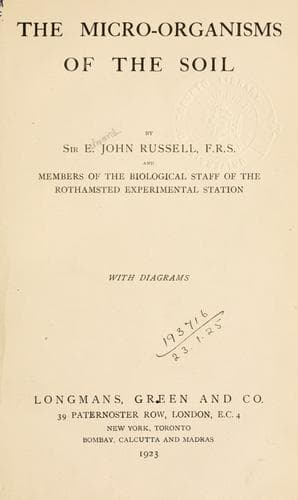
The micro-organisms of the soilRussell, Edward J. (Edward John)
Science
The micro-organisms of the soil
Russell, Edward J. (Edward John)
Soil microbiology
The chemical process by which nitrogen is fixed is quite unknown,
although a number of speculative suggestions have been made. The
appearance of considerable amounts of amino acids in young cultures of
_Azotobacter_ suggests that these may be a step in the process, but at
present the data are too inconclusive to form a basis for theorising.
_Azotobacter_ is very rich in phosphorus, an analysis of the surface
growth in _Azotobacter_ cultures, made by Stoklasa, giving about 60
per cent. of phosphoric acid in the ash. In cultures it has been found
that a considerable amount of phosphate is needed to produce full
development. As would be expected, therefore, nitrogen fixation in soil
is often greatly stimulated by the addition of phosphates. Christensen
has, indeed, found soils where lack of phosphate was the limiting
factor for _Azotobacter_ growth.
_Azotobacter_ is very intolerant of an acid medium, and is very
dependent on the presence of an available base. In cultures this
is usually provided in the form of calcium or magnesium carbonate.
Gainey[21] found that _Azotobacter_ occurred in soils having an acidity
not greater than P_{H} 6·0, and Christensen,[7],[9] in Denmark, has
found a close association between the occurrence of _Azotobacter_ in
soils and the presence of an adequate supply of calcium carbonate. So
close was this association that he devised a technique based on this
fact for detecting a deficiency of lime in a soil sample.
In addition to the groups already discussed, there is a remarkable and
important group of nitrogen-fixing bacteria that inhabit and can carry
on their functions within the root tissues of higher plants. It has
been known at least from classical times that certain leguminous plants
would, under suitable conditions, render the soil more productive. On
the roots of leguminosæ small tubercles are commonly found. These were
noted and figured by Malpighi in the seventeenth century, and for a
long time were regarded as root-galls. As was described in Chapter I.,
the true nature of these tubercles was finally elucidated by Hellriegel
and Wilfarth in 1886. As the result of a series of pot experiments,
they made the very brilliant deduction that the ability to fix
nitrogen, possessed by the legumes, was due to bacteria associated with
them in the tubercles.
Public-domain text, read in full here on John Shaqi.
Reviews
Reviews
No reviews yet
Be the first to share your thoughts on this work.
Join the Discussion
Join the discussion
Sign in to leave a comment or review.
Sign InorCreate an account