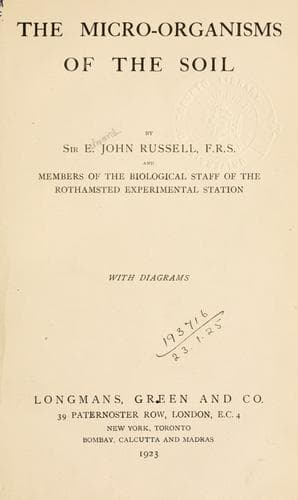
The micro-organisms of the soilRussell, Edward J. (Edward John)
Science
The micro-organisms of the soil
Russell, Edward J. (Edward John)
Soil microbiology
A long controversy has been held as to whether the nodule organisms
found in different host-plants all belong to one species, or whether
there are a number of separate species, each capable of infecting a
small group of host-plants. As the term “species” has at present no
exact meaning when applied to bacteria, the discussion in this form
is unlikely to reach a conclusion. The evidence seems to show that
the nodule organisms form a group that is in a state of divergent
specialisation to life in different host-plants, and that this
specialisation has reached different degrees with different hosts.
Thus the organisms from the nodule of the pea (_Pisum sativum_) will
also produce nodules on vicia, Lathyrus, and Lens, but seem to have
lost the ability normally to infect other legumes. On the other hand,
the bacteria from the nodules of the Soy Bean (_Glycine hispida_)
have become so specialised that they do not infect any other genus
of host-plant, and soy beans are resistant to infection by other
varieties of the nodule organism. Burrill and Hansen,[6] after an
extensive study, divided the nodule bacteria into eleven groups, within
each of which the host-plants are interchangeable. The existence of
different groups of nodule organisms has been confirmed by the separate
evidence of serological tests (Zipfel, Klimmer, and Kruger).[40] The
results of cross-inoculation tests have sometimes been conflicting. It
seems, indeed, that the host-plant has a variable power of resisting
infection, so that when its resistance is lowered it may be capable of
infection by a strange variety of the nodule organism. The question
that has thus arisen of the ability of the legume to resist infection
is of fundamental importance, and its elucidation should throw light on
the relation of plants to bacterial infection as a whole.
The stage of the organism that infects the plant is not at present
known. It may be supposed that it is the motile “swarmer.” The entry is
normally effected through the root-hairs. The hair is attacked close
to the tip, and an enzyme is apparently produced which causes the tip
to bend over in a characteristic manner. The organisms multiply within
the root hair and pass down it, producing a characteristic gelatinous
thread filled with bacteria, in the rod form. This “infection thread”
passes down into the cells of the root tissue, where it branches
profusely. In young stages of nodule formation the branches can be seen
penetrating cells in the pericycle layer. Rapid cell division of these
root cells is induced. In the course of this cell division abnormal
mitotic figures are sometimes found, such as occur in pathological
growths. The cells push outward the root cortical layer, and so form a
nodule.
Public-domain text, read in full here on John Shaqi.
Reviews
Reviews
No reviews yet
Be the first to share your thoughts on this work.
Join the Discussion
Join the discussion
Sign in to leave a comment or review.
Sign InorCreate an account