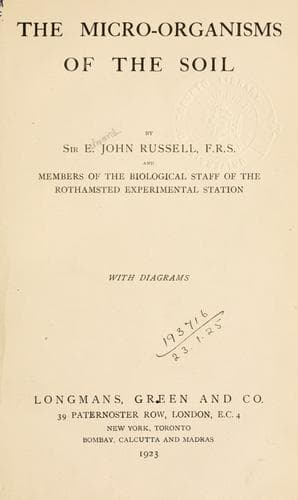
The micro-organisms of the soilRussell, Edward J. (Edward John)
Science
The micro-organisms of the soil
Russell, Edward J. (Edward John)
Soil microbiology
Certain of the cells in the centre of the nodule become greatly
enlarged, and in the fully grown nodule are seen to be filled with
bacteria. Differences have been described in the morphology of the
organisms in different parts of the nodule.[62] Whether the different
stages of the organism are equally capable of fixing nitrogen, or what
is the significance of these stages within the nodule, is not certainly
known. It has been held that it is the irregular bacteroid forms that
are chiefly concerned with nitrogen fixation. In older nodules the
organisms become irregular and stain faintly, and the bacteroidal
tissue breaks down, the nodule finally decaying. In the fixation of
nitrogen that occurs in the nodules, the bacteria without doubt derive
the necessary energy from the carbohydrates of the host-plant. There
is evidence that the plant assists the process of fixation by removing
soluble metabolic products from the neighbourhood of the bacteria.
Golding[22] was able to obtain a greatly increased fixation of nitrogen
in artificial cultures by arranging a filtering device so as to remove
the products of metabolism.
The great practical importance of leguminous crops in agriculture has
led to numerous attempts being made to increase their growth, and the
fixation of nitrogen in them, by inoculating the seed or the soil with
suitable nodule-bacteria. This inoculation can be effected either with
soil in which the host-plant has been successfully grown, and which
should consequently contain the organism in fair numbers, or else pure
cultures of the organisms isolated from nodules may be used. Very
varying results have been obtained with inoculation trials.
In farm practice a leguminous crop has often been introduced into a
new area where it has never previously grown. In such soil it is very
probable that varieties of the nodule organism capable of infecting the
roots may not exist. In such cases inoculation with the right organism
or with infected soil often produces good results.
The more difficult case, however, is that in which the legume crop
has been grown for a long time in the locality, and where the soil
is already infected with right organisms. This, the more fundamental
problem, applies especially to this country. Here it would seem that
inoculation with a culture of the organism will benefit the plant only
(1) if the naturally occurring organisms are present in very small
numbers; or (2) if the organisms in the culture added are more virulent
than those already in the soil. The problem of successful inoculation
would therefore seem to be bound up with that of grading up the
infective virulence of the organism to a higher level.
Public-domain text, read in full here on John Shaqi.
Reviews
Reviews
No reviews yet
Be the first to share your thoughts on this work.
Join the Discussion
Join the discussion
Sign in to leave a comment or review.
Sign InorCreate an account