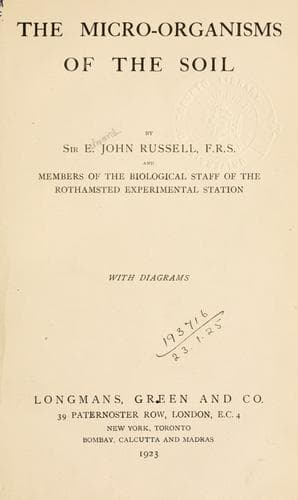
The micro-organisms of the soilRussell, Edward J. (Edward John)
Science
The micro-organisms of the soil
Russell, Edward J. (Edward John)
Soil microbiology
A third type of decomposition was brought into prominence by Liebig
in 1840.[7][B] Reviewing the decomposition of organic matter in the
light of the newer chemistry, he concluded that the process was a
slow chemical oxidation, to which he gave the name “Eremacausis.”
He recognised that humus was formed, but he regarded it only as an
intermediate product, and emphatically denied its importance in
soil fertility. The true fertility agents, in his view, were the
final products--CO₂, potassium and other alkaline salts, phosphates,
silicates, etc. He went on to argue brilliantly that instead of
applying farmyard or similar manures to the soil it was altogether
quicker and better to apply these mineral compounds obtained from
other sources than to wait for the slow process of liberation as the
result of decomposition. For some reason, difficult to understand, he
overlooked nitrification and the part that nitrates might play in soil
fertility. Lawes and Gilbert[6] were much attracted by this new idea;
they showed that it was incomplete because it took no account of the
necessity for supplying nitrogen compounds to the crop. When ammonium
salts were added to Liebig’s ash constituents the resulting mixture had
almost as good a fertilising effect as farmyard manure. Lawes at once
saw the enormous practical importance of this discovery, and set up
a factory for the manufacture of artificial fertilisers. He did not,
however, follow it up more closely on the scientific side.
[B] The numbers refer to the short bibliography on p. 18.
Both Lawes and Gilbert were in constant touch with the idea of
decomposition in the soil, and they attached so much importance to
nitrogen compounds in plant nutrition that it is not easy to understand
how they missed the connection with nitrification. But they did so, and
like other English and German workers of the day, considered that plant
roots assimilated their nitrogen as ammonia. For the first ten years of
the history of Rothamsted only few experiments with nitrates were made,
and not till thirty-five years had elapsed were they systematically
studied.
Public-domain text, read in full here on John Shaqi.
Reviews
Reviews
No reviews yet
Be the first to share your thoughts on this work.
Join the Discussion
Join the discussion
Sign in to leave a comment or review.
Sign InorCreate an account