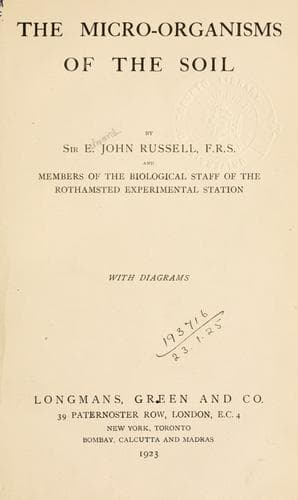
The micro-organisms of the soilRussell, Edward J. (Edward John)
Science
The micro-organisms of the soil
Russell, Edward J. (Edward John)
Soil microbiology
It was by Boussingault[2] and in France that the connection between
nitrification and soil fertility was first recognised. The news came
to England, but it was not accepted, although Way, one of the most
brilliant agricultural chemists of his time, showed that nitrates
were formed in soils to which nitrogenous fertilisers were added, and
that they were comparable in their fertiliser effects with ammonium
salts.[12] “The French chemists,” he wrote in 1856, “are going further,
several of them now advocating the view that it is in the form of
nitric acid that plants make use of compounds of nitrogen. With this
view I do not at present coincide, and it is sufficient here to admit
that nitric acid in the form of nitrates has at least a very high value
as manure.” Indeed, Kuhlmann went so far as to argue that the nitrates
found in the soil were there reduced to ammonia before assimilation
by plants could take place. The water-culture work of the plant
physiologists of the ’sixties finally showed the correctness of the
French view.
Even when the importance of nitrification was realised its mechanism
was not understood: some thought it was chemical, some physical.
Again the explanation came from France. Pasteur in 1862 had expressed
the view that nitrification would probably be a biological action,
since purely chemical oxidation of organic matter was of very limited
occurrence. “Pénétrés de ces idées,” as Schloesing tells us, he and
Müntz in a memorable investigation cleared up the whole problem, and
in 1877 opened the way to a most fruitful field of research.[10] The
formal description is given in his papers in the “Comptes Rendus,”
but a more lively account is given in his lectures before the _École
d’application des Manufacteurs de l’état_, which, though not printed,
were collected and issued in script by his distinguished son, and a
copy of this work is among the treasures of the Rothamsted Library.
He had been asked to study the purification of sewage, and he and Müntz
showed that it was bound up with nitrification. The process was slow in
starting, then it proceeded rapidly. Why, they asked, was the delay?
There should be none if the process were physical or chemical, and the
fact that it occurred strongly suggested biological action. The process
was stopped by chloroform vapour, but could be restarted after the
removal of the vapour by the addition of a little fresh soil.
Public-domain text, read in full here on John Shaqi.
Reviews
Reviews
No reviews yet
Be the first to share your thoughts on this work.
Join the Discussion
Join the discussion
Sign in to leave a comment or review.
Sign InorCreate an account