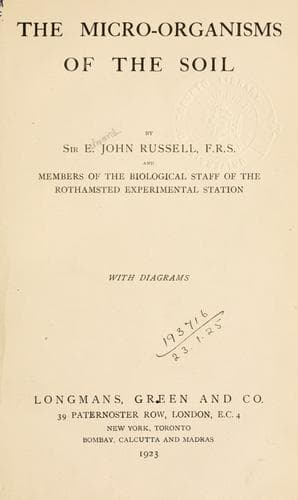
The micro-organisms of the soilRussell, Edward J. (Edward John)
Science
The micro-organisms of the soil
Russell, Edward J. (Edward John)
Soil microbiology
There is another important respect in which soil bacteria influence
plant growth. Their activities result in the release of inorganic
salts, such as potash and phosphates, in a form available for the use
of plants. The release of phosphorus and potassium compounds takes
place in two ways. In the first place, organic matter containing
phosphorus and potassium, in an insoluble form, is attacked by
bacteria, resulting in these elements being set free as inorganic
salts available to the higher plant. Secondly, much of the phosphorus
supplied to the soil from rock minerals is present as insoluble
phosphates, such as apatite and iron phosphate. Much of the potassium,
too, is derived from insoluble silicate minerals. In both cases the
conversion of the insoluble minerals into soluble phosphates and
potassium compounds is brought about to a large extent by solution in
water containing carbonic and other acids. These acids are largely
produced by micro-organisms, which, in addition to carbonic acid,
produce organic acids, and in specialised cases, sulphuric and nitrous
acids. It has been found, for example, that in a compost of soil
with sulphur and insoluble phosphate, sufficient sulphuric acid may
be produced by the oxidation of the sulphur by bacteria to convert
an appreciable amount of phosphate into a soluble form. When we
consider the functions performed by soil bacteria, therefore, it is
not surprising to find that high bacterial activity in the soil is
associated, as a rule, with fertility.
_E._ CHANGES IN BACTERIAL NUMBERS AND ACTIVITIES, AND THEIR RELATION TO
EXTERNAL FACTORS.
The object of soil bacteriologists is to discover means of favouring
the activity of soil bacteria, especially those activities that are
useful to the higher plant. Knowledge is therefore needed of the
changes in numbers and activities of the soil bacteria, and of the
influence of soil conditions on them. The necessity of studying these
changes has required the development of a quantitative technique by
which the numbers of bacteria in the soil and their activities can be
estimated.
Public-domain text, read in full here on John Shaqi.
Reviews
Reviews
No reviews yet
Be the first to share your thoughts on this work.
Join the Discussion
Join the discussion
Sign in to leave a comment or review.
Sign InorCreate an account