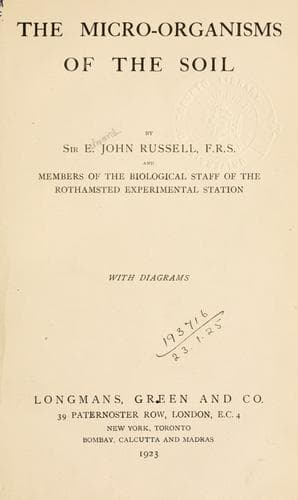
The micro-organisms of the soilRussell, Edward J. (Edward John)
Science
The micro-organisms of the soil
Russell, Edward J. (Edward John)
Soil microbiology
Successful nodule development in a legume crop is also dependent to a
large degree on the soil conditions. The effects of soil conditions on
nodule development have been studied by numerous workers. Moisture has
been found very greatly to affect the nodule development. Certain salts
have a very definite effect on nodule formation.[64] Their effect on
the number of nodules developing has been studied, but the reason for
this effect is unusually difficult to decide. The action is usually a
complex one. Thus phosphates are known to stimulate nodule formation.
They probably act in several ways. In the first place, they may cause
the nodule organisms to multiply in the soil; in the second place, they
produce a greater root development in the plant, thus increasing the
chances of infection; and in the third place, Bewley and Hutchinson[4]
have found that phosphates cause the appearance of the motile stage
of the organism in cultures. A real understanding of the influence of
environment on nodule production will produce great improvements in our
methods of legume cropping.
_D._ THE RELATION OF BACTERIAL ACTIVITIES TO SOIL FERTILITY.
The various activities of the soil bacteria have a vital importance to
the growth of higher plants, which are dependent for their existence
on certain of these processes. In the first place, as we have seen,
bacteria decompose the tissues of higher plants and produce humus
materials, which are essential to the maintenance of good physical
properties in the soil. Then the nitrate supply on which most higher
plants depend is produced by the decomposition of organic nitrogen
compounds by bacteria in their search for energy. The depletion of the
total nitrogen content of the soil through rain and through the removal
of nitrogen in the crops, is to some extent compensated by the fixation
of atmospheric nitrogen by certain bacteria. On the other hand, in the
assimilation of nitrogen compounds to build up protein, the bacteria
are competing with higher plants for one of their essential food
constituents, and their action may, under certain conditions, cause a
temporary nitrogen starvation. One must remember, however, that large
quantities of nitrate are lost from field soils by washing-out through
rain action, especially in winter. The assimilation of nitrate and
ammonia by micro-organisms keeps some of this nitrogen in the soil, and
at certain periods may thus be beneficial.
Public-domain text, read in full here on John Shaqi.
Reviews
Reviews
No reviews yet
Be the first to share your thoughts on this work.
Join the Discussion
Join the discussion
Sign in to leave a comment or review.
Sign InorCreate an account